

Does schema markup for AI search get you cited? What the evidence says
Google says its AI features need no special schema, an Ahrefs study of 1,885 pages found no major uplift in AI citations, and a live-fetch test saw AI systems skip JSON-LD. What each source measured, and the markup still worth keeping.
TL;DR
- Schema markup for AI search has no measured citation benefit so far. Google says its AI features need no special schema, and an Ahrefs study of 1,885 pages that added JSON-LD found no major uplift in AI citations.
- In a searchVIU test on October 30, 2025, none of five AI systems named a price that existed only in JSON-LD. The prices they named were mostly ones visible on the page.
- Microsoft is the partial exception. Bing's webmaster guidelines say structured data may support clearer grounding, and add that it guarantees neither visibility nor traffic.
- FAQ and HowTo markup no longer earn rich results on Google. HowTo results were deprecated in September 2023, and FAQ results stopped appearing on May 7, 2026.
- Markup still worth keeping is the kind that feeds rich results and matches the visible page, such as Article and breadcrumb markup. Facts a page wants cited belong in its visible text.
Does schema markup help AI search cite a page?
Schema markup has not been shown to make AI search cite a page more often. Three kinds of evidence exist on the question, and they are worth keeping apart: what the search engines state, what a controlled study measured, and what a live-fetch test observed.
| Source | Kind of evidence | Date | What it says or found | Stated limit |
|---|---|---|---|---|
| Google, AI optimization guide | Official statement | Last updated July 10, 2026 | Structured data is not required for generative AI search, and no special schema.org markup needs adding | Covers Google Search only |
| Bing, webmaster guidelines | Official statement | No date printed | Structured data may support clearer grounding | No guarantee of visibility or grounding traffic |
| Microsoft Advertising, blog post | Official statement | October 8, 2025 | Schema helps search engines and AI systems understand content | No measurement given |
| Ahrefs, schema study | Controlled study | May 11, 2026 | AI Overviews -4.6%, AI Mode +2.4%, ChatGPT +2.2% after 1,885 pages added JSON-LD, against 4,000 controls | Pages already cited often; 30 days measured; schema types pooled |
| searchVIU, price test | Live-fetch test | Run October 30, 2025 | 0 of 5 AI systems named a price held only in JSON-LD | One page, one day, not repeated |
None of the five rows reports a citation gain from markup. The measurements cover Google AI Overviews, Google AI Mode and ChatGPT only. Neither study measured Copilot citations, so the Microsoft rows rest on Microsoft's own wording. overads ran no test of its own for this post.
What Google says about schema and AI features
Google says its AI features need no special schema markup. Google's guide to optimizing for generative AI search lists overfocusing on structured data among the things a site does not need to do. The guide says structured data is not required for generative AI search and that there is no special schema.org markup to add. The same list covers AI text files, which the guide to llms.txt takes up.
The same passage keeps structured data in the plan for a different reason. Google calls it a good idea to continue using it as part of an overall SEO strategy, because it helps a page be eligible for rich results. That is a statement about how a result looks in Google Search, not about whether an AI answer links to it.
Google's AI features page sets the actual bar for AI Overviews and AI Mode. A page must be indexed and eligible to be shown in Google Search with a snippet. The page says there are no additional technical requirements. It also lists one structured data practice among its general SEO advice: the markup should match the visible text on the page.
Google's guide describes Google Search only. It does not describe how ChatGPT, Perplexity or Copilot choose sources, and the comparison of GEO, AEO and SEO covers how those engines differ.
What Bing and Microsoft say about schema and Copilot
Bing says structured data may help Copilot ground an answer, and promises nothing beyond that. Bing's webmaster guidelines cover Bing search, Copilot and grounding results in one document. Their structured data rule says it “may support clearer grounding” but does not guarantee visibility or grounding traffic. The rule adds that markup must accurately reflect visible content.
The guidelines put more weight on the visible page than on the markup. They say URLs are more likely to be selected for grounding and citations when important information is visible on the URL itself. They warn against hiding critical content behind client-side rendering. Their abuse section says misleading structured data may be ignored.
A Microsoft Advertising post from October 8, 2025 is warmer in tone. It describes schema as code that helps search engines and AI systems understand content, and it names product, review, FAQ and event as labels schema can apply. The post gives no measurement, and Microsoft has published no figure for how often markup changes a Copilot citation.
What the studies measured
The two public measurements found no citation gain from adding schema markup. They test different things, so they are read separately here.
The Ahrefs study, published May 11, 2026, tracked 1,885 pages that added JSON-LD between August 2025 and March 2026. Ahrefs matched them against 4,000 control pages. It counted each page's citations in the 30 days before and the 30 days after the markup first appeared. Its matched comparison gave these changes relative to the controls:
- Google AI Overviews: -4.6%, which Ahrefs calls small but statistically significant.
- Google AI Mode: +2.4%, which Ahrefs calls indistinguishable from zero.
- ChatGPT: +2.2%, which Ahrefs also calls indistinguishable from zero.
Ahrefs summarises the result as “no major uplift” on any platform. It does not read the AI Overviews figure as proof that schema hurts. Both groups were already declining before the markup was added, and Ahrefs says it cannot tell the cause from its data.
The study's own limits matter for anyone applying it. Every page in the sample was already cited often by AI Overviews, so the result may not hold for pages that are not yet cited at all. All JSON-LD types were pooled, so one type could behave differently from another. Only 30 days after the change were measured. The study also reports that 53% of AI-cited pages carry schema, and explains that as correlation: sites that add markup tend to do the rest of their SEO work as well.
The searchVIU test, run on October 30, 2025, asked a narrower question: what an AI system reads when it fetches a page. searchVIU built one page with eight fictitious products. Each product's price sat in exactly one place, so a named price showed which place a system had read.
| Where the price was | ChatGPT | Claude | Gemini | Perplexity | Google AI Mode |
|---|---|---|---|---|---|
| Visible HTML | Named | Not named | Named | Not named | Named |
| Inserted by JavaScript | Not named | Not named | Named | Named | Named |
| JSON-LD only | Not named | Not named | Not named | Not named | Not named |
| JSON-LD inserted by JavaScript | Not named | Not named | Not named | Not named | Not named |
| Hidden microdata | Not named | Not named | Not named | Not named | Not named |
| Visible microdata | Named | Not named | Named | Not named | Not named |
| Hidden RDFa and JSON-LD, conflicting | Not named | Not named | Not named | Not named | Not named |
| Visible RDFa | Named | Not named | Named | Not named | Not named |
| Prices named | 3 of 8 | 0 of 8 | 4 of 8 | 1 of 8 | 2 of 8 |
No system named a price that existed only in markup. Where a system named a price inside microdata or RDFa, that price was also visible on the page. searchVIU records that Perplexity and Google AI Mode found nothing until the page was indexed, and the table shows their answers after indexing.
searchVIU states the limits plainly. The test used one page on one day and has not been repeated. The systems have received new models since. The test did not check whether Google AI Overviews or Copilot use structured data that sits in a search index.
Why FAQ and HowTo markup no longer pay
FAQ and HowTo markup no longer pay because Google stopped showing the rich results they existed to earn. The dates come from Google's own pages.
- August 8, 2023: Google's post on changes to HowTo and FAQ rich results limited FAQ rich results to well-known, authoritative government and health websites. It limited HowTo rich results to desktop.
- September 14, 2023: an update to the same post said Google Search no longer showed HowTo rich results on desktop either, and called the result type deprecated.
- May 8, 2026: Google's documentation changelog recorded a deprecation notice for the FAQ rich result. It said the feature would no longer appear in Google Search starting May 7, 2026.
- June 15, 2026: the same changelog recorded that the FAQ rich result documentation had been removed.
The Ahrefs study pooled FAQ markup with every other JSON-LD type, so it gives no separate figure for FAQ markup and AI citations. The Microsoft Advertising post still names FAQ as a label schema can apply. No source read for this post measures a citation benefit from FAQ markup on its own.
A visible list of questions and answers is a separate thing from the markup. It is page text, and page text is what the searchVIU test saw systems read.
Which schema markup is still worth keeping
Schema markup worth keeping is the kind that still feeds a Google rich result and describes what the page visibly says. Google's AI guide gives that reason itself: rich result eligibility.
- Article markup. Google's Article structured data page says it can help Google understand a page and show better title text, images and date information. The page lists no required properties. It recommends author, datePublished, dateModified, headline and image.
- Breadcrumb markup. Google's changelog entry of January 22, 2025 says breadcrumbs appear on desktop search results only, not on mobile.
- Any type with a live rich result that fits the page, such as Product on a product page. Google's AI guide separately names Merchant Center feeds and Business Profiles as the route for product and local business details.
One rule applies to all of it. Google's general structured data guidelines say not to mark up content that is not visible to readers. The guidelines say a structured data manual action removes a page's eligibility for rich results. They add that it does not affect how the page ranks in web search. Bing's guidelines carry the same rule about visible content.
What helps AI citations more than markup
What the sources point to instead of markup is the visible page and whether a search engine can index it. Four steps follow from the pages above.
- Put each fact in the visible text. In the searchVIU test, visible prices were the ones most systems named. Bing's guidelines ask for important information to be visible on the URL itself.
- Serve key facts in the HTML. Bing's guidelines warn against hiding critical content behind client-side rendering. In the searchVIU test, ChatGPT named no price that JavaScript inserted.
- Stay indexed and snippet-eligible. Google's AI features page makes that the requirement for a supporting link in AI Overviews and AI Mode.
- Publish something that is not a commodity. Google's AI guide asks for unique, expert-led content that adds value beyond common knowledge.
Measuring the result is a separate job from any of these. The guide to tracking AI traffic in GA4 covers the clicks, and the guide to being cited in ChatGPT covers the wider work.
Where overads fits
overads does not generate, validate or audit schema markup, so overads has no part in the work above. It does not crawl a site, it does not test rich results, and it does not measure how often AI answers cite a page. Google's own testing tools and Search Console do the first two jobs, and a dedicated AI visibility tracker does the third.
The overads blog follows the evidence in this post. On November 18, 2026, each post on this blog emits two JSON-LD blocks: a BlogPosting and a BreadcrumbList. The BlogPosting repeats the visible Sources list as its citations, so the markup names nothing the page does not show. A unit test in the site's code fails if a blog post emits FAQPage or HowTo markup. Several overads marketing pages outside the blog still carry FAQPage markup, which earns no rich result today.
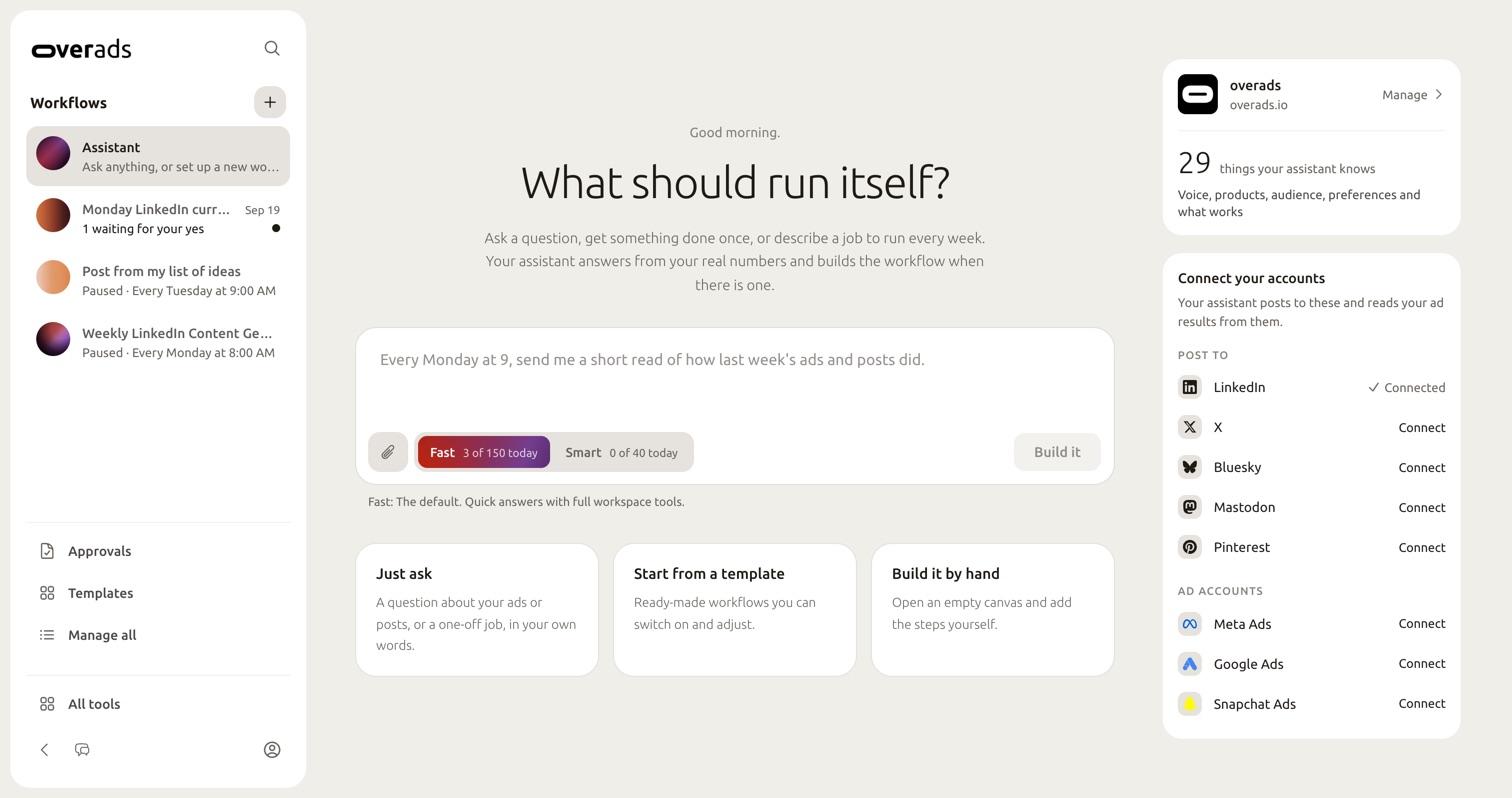
overads is an AI marketing agent for small teams, described beside its alternatives in AI marketing agents compared. It drafts posts, can hold them for a person's approval, and publishes them to Instagram, Facebook, LinkedIn, X, Bluesky, Mastodon and Pinterest, which the social media scheduler overview covers. It also connects ad accounts: Meta and Google ad changes run after you approve them; X and Snapchat connect read-only, so overads proposes and a person applies.
One place where structured data does reach an AI assistant is outside the web page altogether. An assistant such as Claude or ChatGPT can work inside an overads workspace through the overads MCP server, which returns structured results to the assistant directly. That is a tool connection, not search, and it has no effect on whether an AI answer cites a website.
Frequently asked questions
Should existing FAQPage markup be removed?
Google's August 8, 2023 post said there was no need to remove it, because unused structured data does not cause problems for Search. The May 2026 changelog entry that ended FAQ rich results does not say anything different.
Is JSON-LD better than Microdata or RDFa for AI systems?
The evidence does not show a difference. Google's structured data guidelines list all three as supported formats and mark JSON-LD as recommended. In the searchVIU test the format made no difference, and the Ahrefs study measured JSON-LD only.
Does schema injected with JavaScript behave differently?
It is less tested. The Ahrefs study looked only at schema in the page's HTML and says so. In the searchVIU test, no system named the price that sat in JSON-LD inserted by JavaScript.
Sources
- Optimizing your website for generative AI features on Google Search. Google Search Central, Jul 10, 2026. Accessed Nov 18, 2026.
- AI features and your website. Google Search Central, Dec 10, 2025. Accessed Nov 18, 2026.
- Latest Google Search Documentation Updates. Google Search Central. Accessed Nov 18, 2026.
- Changes to HowTo and FAQ rich results. Google Search Central Blog, Aug 8, 2023. Accessed Nov 18, 2026.
- General structured data guidelines. Google Search Central, Jul 10, 2026. Accessed Nov 18, 2026.
- Article structured data. Google Search Central, Sep 8, 2026. Accessed Nov 18, 2026.
- Bing Webmaster Guidelines. Bing Webmaster Tools. Accessed Nov 18, 2026.
- Optimizing Your Content for Inclusion in AI Search Answers. Microsoft Advertising, Oct 8, 2025. Accessed Nov 18, 2026.
- We Tracked 1,885 Pages Adding Schema. AI Citations Barely Moved.. Ahrefs, May 11, 2026. Accessed Nov 18, 2026.
- Do AI systems really read schema markup?. searchVIU, Dec 2, 2025. Accessed Nov 18, 2026.
Drafted with AI assistance, then checked against primary sources and the product itself by the overads team.
Keep reading
AI search · 11 min read
GEO vs AEO vs SEO: what each means and which to work on first
SEO, AEO and GEO name overlapping work, and Google counts all three as SEO. What each term means, what the KDD 2024 GEO paper and the NeurIPS 2025 C-SEO Bench measured, which reports show each one, and where a small team should start.
AI search · 9 min read
Should you opt out of AI Overviews? The Search Console control, explained
Google now lets any site leave AI Overviews and AI Mode from Search Console. What the control removes, how it differs from nosnippet and Google-Extended, why its report has no clicks, and how to test it on one folder first.
AI search · 6 min read
How to rank in ChatGPT: what actually gets a brand cited
ChatGPT answers a buying question with a short list of names and a handful of cited pages. Here is what we have seen decide whether a brand makes that list, and a routine for getting there without gaming anything.
Put the facts where people and assistants can read them
overads drafts posts, can hold them for your approval, and publishes them to Instagram, Facebook, LinkedIn, X, Bluesky, Mastodon and Pinterest.
Get started