

What is llms.txt, and do AI search engines read it?
llms.txt is a Markdown index a site publishes for AI agents. Google Search says it ignores the file, and no AI engine's crawler page says its crawler reads one. What the August 2026 version asks for, and how to write one.
TL;DR
- llms.txt is a proposed Markdown file, served at /llms.txt or under a subpath, that gives AI agents a short summary of a site and links to its most useful pages. Jeremy Howard published the proposal on September 3, 2024 and revised it as version 2 in August 2026.
- Google says Google Search ignores llms.txt. The crawler pages of OpenAI, Anthropic and Perplexity, and Bing's Webmaster Guidelines, do not say their crawlers read a site's llms.txt (all read November 28, 2026).
- Version 2 says who the file is for: agents helping a user, most often coding agents reading documentation. It adds link relations so an agent can find the file and a page's Markdown version.
- llms.txt does not control access. robots.txt states what crawlers may fetch, and a sitemap lists pages for search engines. llms.txt is a curated reading list.
- overads generates its llms.txt from the same content its docs pages render, and a test fails when the committed file drifts. On November 28, 2026 the file was 41 KB, longer than the proposal intends.
What llms.txt is
llms.txt is a Markdown file that a website publishes to give AI agents a short summary of the site and a list of links to its most useful pages. The llms.txt proposal was written by Jeremy Howard and first published on September 3, 2024. The page now carries the title "The /llms.txt file, v2".
The proposal states the problem it addresses. Web pages are built for people, and an HTML page wraps its information in navigation, ads and JavaScript. Turning that back into clean text is, in the proposal's words, difficult and imprecise. A model's context window is also too small to hold most websites whole. The file is meant to put concise information in one known place.
llms.txt is a proposal, not a rule that any crawler has to follow. The proposal calls itself one throughout and says the specification is open for community input. It reports adoption on the publishing side: thousands of sites publish the file, and documentation platforms generate it automatically. Whether an AI search engine reads the file is a separate question, answered below from each company's own page.
What the llms.txt proposal asks a site to publish
The llms.txt proposal asks a site to publish two things: the llms.txt file itself, and a clean Markdown version of each page an agent might need. The file may sit at the site root, at /llms.txt, or under a path such as /docs/llms.txt. A file covers the pages under its path. Where more than one file applies, the proposal says an agent should use the most specific one.
The proposal sets the order of the file's parts:
- An H1 with the name of the project or site. This is the only required part.
- A blockquote with a short summary.
- Any further detail as paragraphs or lists, with no headings.
- Sections under H2 headings, each holding a list of links. An item is a Markdown link, then optionally a colon and a note.
For the Markdown versions, the proposal asks for the same address as the page with .md added (page.html.md) or with the extension replaced (page.md). The links in the file should point to those versions. The proposal says the file itself should stay small enough to fit in context, with the detail behind the links.
Version 2 changed several points. The proposal's Changes page dates it August 2026 and gives the reasons.
| Point | Version 1 (September 2024) | Version 2 (August 2026) |
|---|---|---|
| Finding the files | Not covered | Link relations: alternate with type text/markdown for a page's Markdown version, describedby for the llms.txt that covers it |
| Markdown address | page.html.md only | page.html.md or page.md |
| A file under a path | Allowed, meaning not defined | Covers the pages under its path; the most specific file applies |
| How the file is read | Not stated; a tool expanded the file into one context | Agents view or search the file, then follow links; the tool is no longer part of the proposal |
| The Optional section | Told the tool what to leave out | A convention for secondary links, with no mechanical meaning |
The link relations can be HTML link elements or an HTTP Link header. The proposal notes that the header form can be added in a web server or CDN without editing any page.
Which AI engines say they read llms.txt
No AI search engine's own page read for this article says its crawler reads a site's llms.txt, and Google Search says outright that it ignores the file. The table gives each company's position from its own page, read on November 28, 2026. Where a page is silent, the table says so.
| Company | What its page says | Source |
|---|---|---|
| Google Search does not use llms.txt and ignores it. Keeping one for other services will neither harm nor help visibility or rankings in Google Search. | Google Search Central guide, last updated July 10, 2026 | |
| Chrome Lighthouse | Has an llms.txt audit among its agentic browsing audits. It flags a page only when a server error occurs while fetching the file. A 404 is marked Not Applicable. | Chrome for Developers, last updated May 5, 2026 |
| OpenAI | Names OAI-SearchBot, GPTBot and ChatGPT-User and points site owners to robots.txt. It does not say any of them reads a site's llms.txt. | Overview of OpenAI Crawlers |
| Anthropic | Names ClaudeBot, Claude-User and Claude-SearchBot and points site owners to robots.txt. It does not mention llms.txt. | Claude Help Center |
| Perplexity | Names PerplexityBot and Perplexity-User and recommends allowing PerplexityBot in robots.txt. It does not say either reads a site's llms.txt. | Perplexity Crawlers |
| Microsoft Bing | The Webmaster Guidelines, which cover Bing search, Copilot and grounding results, do not mention llms.txt. | Bing Webmaster Guidelines |
Google's statement is the only explicit one. Its guide to generative AI features in Google Search lists llms.txt files among the things a site can ignore for Google Search. The guide adds that it is fine to keep such a file for other services or systems that use it.
Google's browser tooling takes a different line from its search engine. The Lighthouse llms.txt audit page calls the file an emerging convention for LLMs and AI agents. It says that without the file, agents may spend more time crawling a site to understand its structure. The same page says providing the file is optional at the moment.
The other pages describe crawlers and the controls for them. OpenAI's overview of its crawlers, Anthropic's help page on its crawlers and Perplexity's crawler page each name their user agents and point to robots.txt. Bing's Webmaster Guidelines do the same for Bingbot. Silence is not a denial. It means none of these pages gives a reason to expect a citation from publishing the file.
The same companies do publish llms.txt files for their own developer documentation. The proposal names three of them, and Perplexity's documentation site shows a banner pointing AI agents to its own. A check for this article requested each address once on November 28, 2026, with a desktop browser user agent and redirects followed.
| Company | Developer documentation | Main sites |
|---|---|---|
| OpenAI | developers.openai.com/llms.txt: 200 | openai.com and chatgpt.com: 404 |
| Anthropic | docs.anthropic.com/llms.txt: 200, after a redirect to platform.claude.com | anthropic.com and claude.com: 404 |
| ai.google.dev/gemini-api/docs/llms.txt: 200, after a redirect to aistudio.google.com | google.com and developers.google.com: 404 | |
| Perplexity | docs.perplexity.ai/llms.txt: 200 | perplexity.ai: 404 |
| Microsoft | learn.microsoft.com/llms.txt: 404 | bing.com and microsoft.com: 404 |
The pattern matches what version 2 of the proposal says about use. It says llms.txt files are used most heavily for software documentation, where coding agents follow them to API references and tutorials. One request from one place on one day is a small check, and a 404 can change. It shows where these companies put the file on that day: on documentation, not on the sites people search from.
llms.txt vs robots.txt vs a sitemap
llms.txt, robots.txt and a sitemap do three different jobs: robots.txt states what crawlers may fetch, a sitemap lists pages for search engines, and llms.txt is a short reading list for an agent. The proposal says llms.txt is designed to coexist with the other two.
robots.txt is the only one of the three with a published standard behind it. RFC 9309, dated September 2022, defines the Robots Exclusion Protocol and places the file at the top level of a site. It also states a limit: the rules are not a form of access authorization. A crawler chooses to honour them.
A sitemap is an XML file that lists a site's URLs. The sitemaps.org protocol page sets the format: one url entry for each URL, with optional tags such as lastmod for when a page last changed.
The proposal gives three reasons a sitemap does not replace llms.txt. A sitemap often does not list the Markdown versions of pages. It does not include links to other sites, even where they help. And it usually covers more than fits in a context window.
The practical order follows from the table above. Every company in it documents robots.txt as the control for its crawlers, so a wrong robots.txt rule can keep a site out of an AI answer. None of them documents llms.txt as a way in.
What llms-full.txt is
llms-full.txt is not part of the llms.txt proposal. Neither the proposal page nor its Changes page mentions the name. It is a convention from documentation platforms.
Mintlify, a documentation platform the proposal links to, defines the pair in its llms.txt documentation. There, llms.txt is an index of links with descriptions, and llms-full.txt combines the whole documentation site into one file. Mintlify says it adds a note that the file may be truncated when it passes 100 KB.
The two files pull in opposite directions. Version 2 of the proposal expects an agent to read a small index and fetch only the pages it needs. A full file hands over everything at once, which suits a site whose documentation is small.
How to write an llms.txt file
An llms.txt file is written as plain Markdown in the order the proposal sets: a title, a summary, notes, then lists of links. The steps below restate the proposal's format and its guidelines.
A small file in that format, for an invented shop:
# Example Coffee Roasters

> Example Coffee Roasters sells whole-bean coffee online and ships within the UK.

Orders placed before 2 pm ship the same working day. We do not sell ground coffee.

## Shop

- [Coffee range](https://example.com/coffee.md): every coffee on sale, with roast level and price
- [Delivery and returns](https://example.com/delivery.md): costs, times and the returns policy

## Optional

- [Our story](https://example.com/about.md)
The proposal lists four guidelines for the wording:
- Use concise, clear language.
- Give each link a brief, informative description.
- Avoid ambiguous terms and unexplained jargon.
- Test the file by asking an agent questions with only the llms.txt to start from.
Many sites do not need to write the file by hand. The proposal's integrations list names documentation platforms and site builders that generate one, among them Mintlify, GitBook, Yoast SEO for WordPress and Wix.
A generated or hand-written file has one failure that matters more than its format: it goes stale. A summary that names an old price or a retired feature is read by an agent as current. The next section describes how one site guards against that.
How overads generates its own llms.txt
overads generates its llms.txt with a script, from the same content modules that its documentation pages render. This section describes the overads code and the live files as they stood on November 28, 2026.
- Two files. The overads llms.txt is the index: what the product is, the docs links, the API routes, the MCP tools and the publishing channels. The overads llms-full.txt holds the full text of every page under the overads docs.
- Facts come from registries. The list of live publishing channels, the ad platforms, the plan and its price are read from the same registries the product pages use. A channel that is still in review is written as in review.
- A test compares the files. A unit test builds both files again and fails when the committed copies differ.
- A second test reads the content. A comment in that test records why. The file once matched its generator while still describing retired plans, because the generator's own prose was stale. The test now checks the text for retired plan names and for links to docs pages that do not exist.
Measured against the proposal on November 28, 2026, the overads file fell short in four ways. Markdown versions of the docs pages, with the link relation that points to them, were in review on that date and not yet live, so the third and fourth points describe the site as it was measured.
- It is long. The index is 41,076 bytes, with 122 links under 12 H2 headings. The proposal expects a file small enough to fit in context.
- Not every list item is a link. Of 230 list items, 117 start with a link. The proposal's format calls for a link in each item of a file list. The file also uses H3 headings, which the format does not describe.
- The docs pages have no Markdown versions. The links in the file point to HTML pages. A request for
/docs/getting-started.mdreturned 404. - No link relations. The docs pages send no
Linkheader and carry nodescribedbylink element, the discovery method version 2 added.
One thing was not measured. No server logs were read for this article, so it does not say which agents request the overads file or how often.
Where overads fits
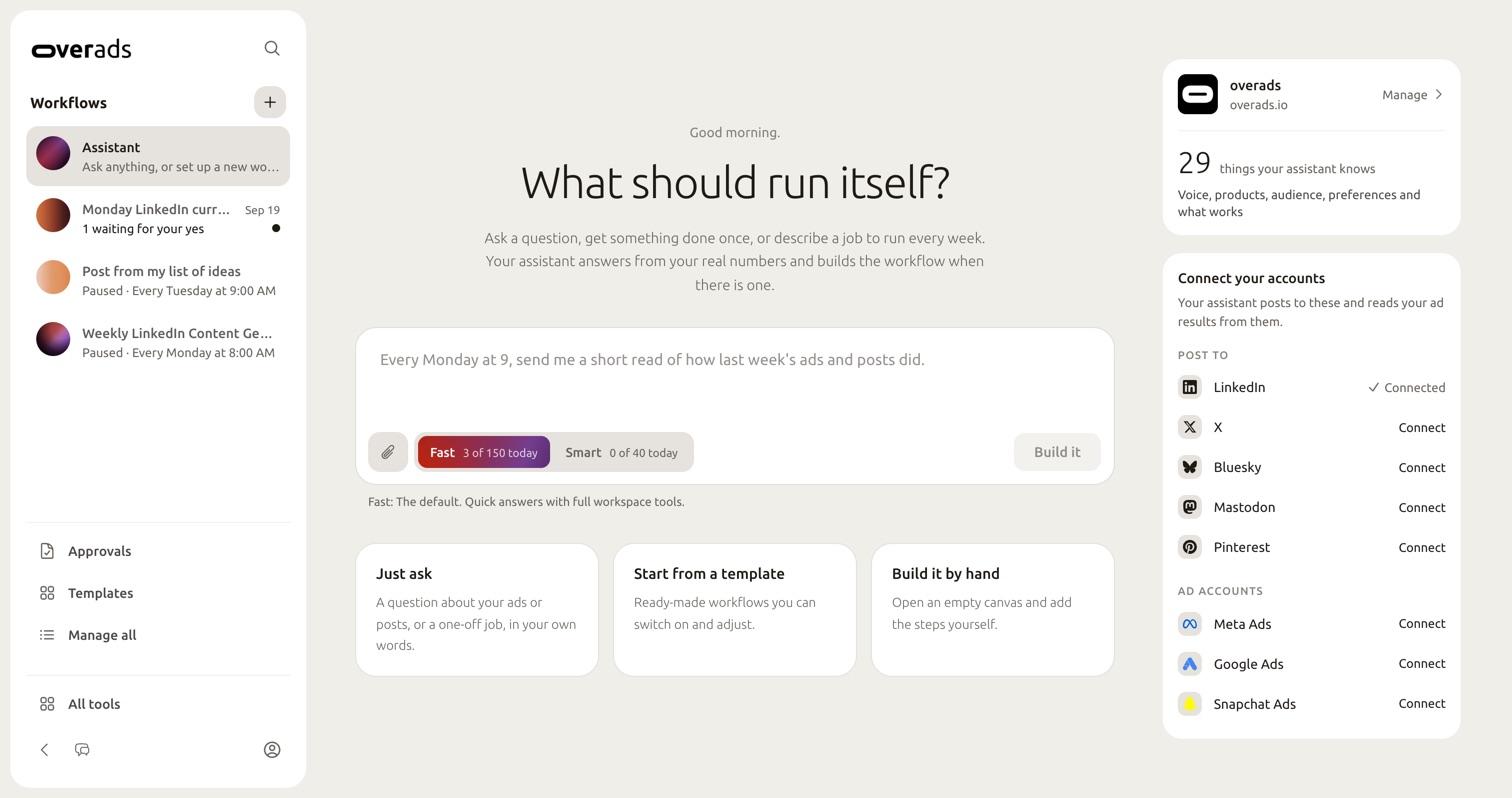
overads fits a team that wants an AI assistant to do marketing work through a documented interface, and it is not a tool for making or checking an llms.txt file. An assistant reaches overads through the overads MCP server and its API, and the assistant setup page has a section written for the agent itself.
What overads does not do, read from the code on November 28, 2026:
- It does not generate or host an llms.txt for a customer's website.
- It does not audit a site's llms.txt.
- It does not report which AI agents fetch a site's files.
When another route fits better: a documentation site on a platform that generates the file already has one, and a WordPress or Wix site can use the options in the proposal's integrations list. Lighthouse checks whether the file is served without a server error. For what moves a citation in an AI answer, the guide to GEO, AEO and SEO and the evidence on schema markup for AI search cover the documented requirements. For what an MCP server can do on social networks, see the social media MCP server page.
Frequently asked questions
Should llms.txt live at /.well-known/llms.txt?
The proposal says no. It places the file at the site root or under any path, and argues that /.well-known/ exists only at the root of a host, so someone who controls only a path could not publish one. Mintlify's documentation says it serves the file at both locations.
Can llms.txt stop AI models from training on my content?
No. The proposal says llms.txt is used on demand while an agent helps a user, and that robots.txt is the file that says what access is acceptable. OpenAI and Anthropic each name the crawler that collects training data, GPTBot and ClaudeBot, and say a robots.txt rule for it is the opt-out.
Does a WordPress or Wix site get an llms.txt automatically?
The proposal's integrations list says Wix generates an llms.txt for every Wix site, and that the Yoast SEO and AIOSEO plugins generate one on WordPress. This article did not test those products.
Sources
- The /llms.txt file, v2. Jeremy Howard, llmstxt.org, Sep 3, 2024. Accessed Nov 28, 2026.
- Changes: v2 (August 2026). llmstxt.org. Accessed Nov 28, 2026.
- Optimizing your website for generative AI features on Google Search (last updated July 10, 2026). Google Search Central. Accessed Nov 28, 2026.
- Lighthouse agentic browsing audits: llms.txt (last updated May 5, 2026). Chrome for Developers. Accessed Nov 28, 2026.
- Overview of OpenAI Crawlers. OpenAI. Accessed Nov 28, 2026.
- Does Anthropic crawl data from the web, and how can site owners block the crawler?. Anthropic, Claude Help Center. Accessed Nov 28, 2026.
- Perplexity Crawlers. Perplexity. Accessed Nov 28, 2026.
- Bing Webmaster Guidelines. Microsoft Bing. Accessed Nov 28, 2026.
- RFC 9309: Robots Exclusion Protocol. IETF, RFC Editor, Sep 1, 2022. Accessed Nov 28, 2026.
- Sitemaps XML format. sitemaps.org. Accessed Nov 28, 2026.
- llms.txt. Mintlify documentation. Accessed Nov 28, 2026.
- overads llms.txt. overads. Accessed Nov 28, 2026.
Drafted with AI assistance, then checked against primary sources and the product itself by the overads team.
Keep reading
AI search · 11 min read
GEO vs AEO vs SEO: what each means and which to work on first
SEO, AEO and GEO name overlapping work, and Google counts all three as SEO. What each term means, what the KDD 2024 GEO paper and the NeurIPS 2025 C-SEO Bench measured, which reports show each one, and where a small team should start.
AI search · 10 min read
Does schema markup for AI search get you cited? What the evidence says
Google says its AI features need no special schema, an Ahrefs study of 1,885 pages found no major uplift in AI citations, and a live-fetch test saw AI systems skip JSON-LD. What each source measured, and the markup still worth keeping.
AI search · 6 min read
How to rank in ChatGPT: what actually gets a brand cited
ChatGPT answers a buying question with a short list of names and a handful of cited pages. Here is what we have seen decide whether a brand makes that list, and a routine for getting there without gaming anything.
Let an assistant do the marketing work, not just read about it
overads gives an AI assistant a documented API and an MCP server for scheduling posts and reading results, and a post waits for a person's approval when the workspace asks for it.
Get started