

How to track AI traffic in GA4: ChatGPT, Perplexity and Gemini referrals
GA4 has filed AI assistant visits in their own default channel since May 13, 2026, and counts AI Overviews clicks as Organic Search. Where each engine lands, when a custom channel group helps, and Google's example regex, tested.
TL;DR
- To track AI traffic in GA4, open the Acquisition reports and read the AI Assistant channel. Since May 13, 2026, GA4 gives a visit whose referrer matches its list of AI assistants the medium ai-assistant and files it in that default channel.
- Clicks from Google's AI Overviews and AI Mode are not in the AI Assistant channel. Google's channel descriptions file them under Organic Search.
- A custom channel group is needed only for assistants Google's list misses. A standard GA4 property allows 2 custom groups of up to 50 channels each, and Google says they apply to reports retroactively.
- Google's example regex for an AI channel matched 8 of 12 AI assistant hostnames in a test for this post, and 3 of 5 hostnames that are not assistants. It missed Deepseek and Grok.
- GA4 counts visits, not mentions. An AI answer that names a brand without a click leaves nothing in GA4; Search Console and Bing Webmaster Tools report AI impressions and citations instead.
How GA4 tracks AI traffic by default
GA4 tracks AI assistant traffic with a default channel named AI Assistant, which Google added on May 13, 2026. Google's Analytics release notes for that date list three changes to the traffic source dimensions:
- Medium: the value
ai-assistantis assigned automatically when the referrer matches a recognised AI assistant. - Channel group: those visits are filed under the AI Assistant channel.
- Campaign: those visits carry the campaign name
(ai-assistant).
The channel needs no setup. Google's default channel group page defines it in one line: the medium exactly matches ai-assistant. To read it, open the User acquisition or Traffic acquisition report under Acquisition and find the AI Assistant row. Adding the source as a secondary dimension splits the row by assistant.
The release note does not say whether visits from before May 13, 2026 were reclassified. A property with older AI referrals should not assume they moved into the new channel.
Where GA4 files each AI engine's clicks
GA4 files a click from an AI engine in one of four channels, depending on the engine and on whether a referrer arrives. The table sets out what Google's pages state and marks the rows that are inference.
| Where the click comes from | Default channel | Basis |
|---|---|---|
| ChatGPT, Gemini, Deepseek, Copilot, Grok | AI Assistant | Named in Google's description of the channel |
| Claude | AI Assistant | Named in the May 13, 2026 release note |
| Perplexity | Not stated | Named only in Google's custom channel example, not in the default channel's description |
| Google AI Overviews and AI Mode | Organic Search | Stated in Google's descriptions of both channels |
| An assistant that is not on Google's list | Referral | Inference from the Referral definition (medium is referral, app or link) |
| Any assistant, when no referrer arrives | Direct | Inference from the Direct definition (source is (direct), medium is (none) or (not set)) |
Google does not print its full list of AI assistants on the help page. The page says the medium is set when the referrer matches a list of AI Assistants and names five as examples. Whether a given assistant's app passes a referrer at all is not documented by Google. Perplexity's crawler page and OpenAI's crawler overview do not say either.
The Organic Search row matters most for reading the numbers. Google's description of the AI Assistant channel says it excludes AI Overviews and AI Mode, and its description of Organic Search says that channel includes them. A site cannot separate those clicks inside GA4 from Google's pages alone.
Does ChatGPT add utm_source=chatgpt.com to its links?
This post could not confirm at OpenAI that ChatGPT adds utm_source=chatgpt.com to the links it cites. The page that documented it was OpenAI's publishers and developers FAQ. On November 17, 2026 that address redirected to an unrelated help article, and OpenAI's crawler overview does not mention the parameter.
The parameter still matters for GA4, because a link that carries only a source is incomplete. Google's page on campaign URLs says missing UTM parameters result in (not set) values in reports. Google's pages do not say which rule wins when a visit has both a tagged source and a referrer on the AI assistant list.
The check takes a minute in any property. Open Traffic acquisition, filter the source to values containing chatgpt, and read the medium column. Rows with the medium ai-assistant are in the AI Assistant channel. Rows with (not set) are counted elsewhere and are the case for a custom channel group.
How to build a custom AI channel group in GA4
A custom AI channel group in GA4 is a copy of the default channel group with one extra channel placed above Referral. Google's custom channel groups page carries an AI assistants example. Its example and its general instructions combine into these steps:
- In Admin, under Data display, click Channel groups.
- Click Create new channel group, which starts from a copy of the default group.
- Click Add new channel and name it, for example AI assistants.
- Add a condition on the source, choose matches regex, and enter the pattern.
- Click Save channel.
- Click Reorder and drag the new channel above Referral, then click Apply.
- Click Save group.
Google's example does not name the dimension for the condition. This post uses the source, because the source is the field that holds a referring site. The order is the step that decides the result. The same page says traffic is included in the first channel whose definition it matches, so an AI channel left below Referral receives nothing that Referral already claimed.
Three limits from that page shape the plan. A standard property allows 2 custom channel groups beside the default one, and a 360 property allows 5. Each group holds up to 50 channels. Creating and editing a group needs the Editor role or above. Google also says custom channel groups can be applied to reports retroactively, which makes a custom group the documented way to classify AI visits from before May 13, 2026.
Google's example regex, tested against 17 hostnames
Google's example regex for an AI assistants channel matched 8 of 12 AI assistant hostnames and 3 of 5 hostnames that are not assistants, in a test run for this post on November 17, 2026. The pattern on Google's page is:
^.*ai|.*\.openai.*|.*chatgpt.*|.*gemini.*|.*gpt.*|.*copilot.*|.*perplexity.*|.*google.*bard.*|.*bard.*google.*|.*bard.*|.*.*gemini.*google.*$
The method: Google's regex page says Analytics regex is a full match by default, so each hostname was tested in Python with re.fullmatch, in lower case. The test ran outside GA4, on hostnames typed by hand, so it shows what the pattern accepts and not what any property recorded.
| Hostname | Kind | Google's example | Narrower pattern |
|---|---|---|---|
| chatgpt.com | AI assistant | Match | Match |
| chat.openai.com | AI assistant | Match | Match |
| perplexity.ai | AI assistant | Match | Match |
| claude.ai | AI assistant | Match | Match |
| gemini.google.com | AI assistant | Match | Match |
| copilot.microsoft.com | AI assistant | Match | Match |
| meta.ai | AI assistant | Match | Match |
| chat.mistral.ai | AI assistant | Match | Match |
| chat.deepseek.com | AI assistant | No match | Match |
| grok.com | AI assistant | No match | Match |
| you.com | AI assistant | No match | No match |
| poe.com | AI assistant | No match | No match |
| otter.ai | Not an assistant | Match | No match |
| bombardier.com | Not an assistant | Match | No match |
| gptzero.me | Not an assistant | Match | No match |
| mail.google.com | Not an assistant | No match | No match |
| bing.com | Not an assistant | No match | No match |
Two parts of Google's pattern explain the false matches. Its first branch accepts any source that ends in the letters ai, which is why claude.ai matches without being named and why otter.ai matches too. Its bard and gpt branches accept those letters anywhere, which catches bombardier.com and gptzero.me. Deepseek and Grok are missed, although Google's own description of the default AI Assistant channel names both.
The narrower pattern names each assistant instead:
.*(chatgpt|openai|perplexity|claude\.ai|anthropic|gemini\.google|copilot|deepseek|grok|meta\.ai|mistral\.ai).*
The narrower pattern matched 10 of the 12 assistants and none of the 5 other hostnames. It leaves out you.com and poe.com on purpose, because a pattern for those short names also accepts any longer address that ends the same way. Google's page gives the same advice about any such pattern: update it when the addresses or the list of assistants change.
What GA4 cannot see about AI search
GA4 cannot see an AI answer that mentions a brand without a click, because GA4 records visits to a site and nothing else. Four gaps follow from Google's and other vendors' pages.
- Mentions with no click. A cited or recommended brand produces no visit, so the AI Assistant channel undercounts how often assistants name a site. AI share of voice is the measure built for that question.
- Google's own AI features. Google's AI features guide says AI Overviews and AI Mode are reported in Search Console's Performance report within the Web search type. Search Console's generative AI performance report adds impressions for those two features, as the guide to that report and its control explains.
- Copilot citations. Microsoft's AI Performance report in Bing Webmaster Tools, announced February 10, 2026, counts citations, cited pages and grounding queries. The announcement lists no click measure.
- Assistants reading a page. OpenAI's crawler overview says ChatGPT may visit a page with the ChatGPT-User agent when a person asks a question. Google's known bot-traffic exclusion page says GA4 excludes traffic from known bots and spiders automatically and does not show how much was excluded. Server logs are where those fetches can be counted.
The practical reading is narrow. The AI Assistant channel answers how many visits assistants sent and what those visitors did next. It does not answer how visible a brand is in AI answers, which the guide to being cited in ChatGPT treats as a separate job.
Where overads fits
overads does not read Google Analytics, so overads has no part in the setup above. It does not build channel groups, it does not report AI referrals, and it does not measure how often AI answers mention a brand. Every step in this post is done in GA4 itself.
overads is an AI marketing agent for small teams, described beside its alternatives in AI marketing agents compared. It drafts posts, can hold them for a person's approval, and publishes them to Instagram, Facebook, LinkedIn, X, Bluesky, Mastodon and Pinterest, which the social media scheduler overview covers. It also connects ad accounts: Meta and Google ad changes run after you approve them; X and Snapchat connect read-only, so overads proposes and a person applies.
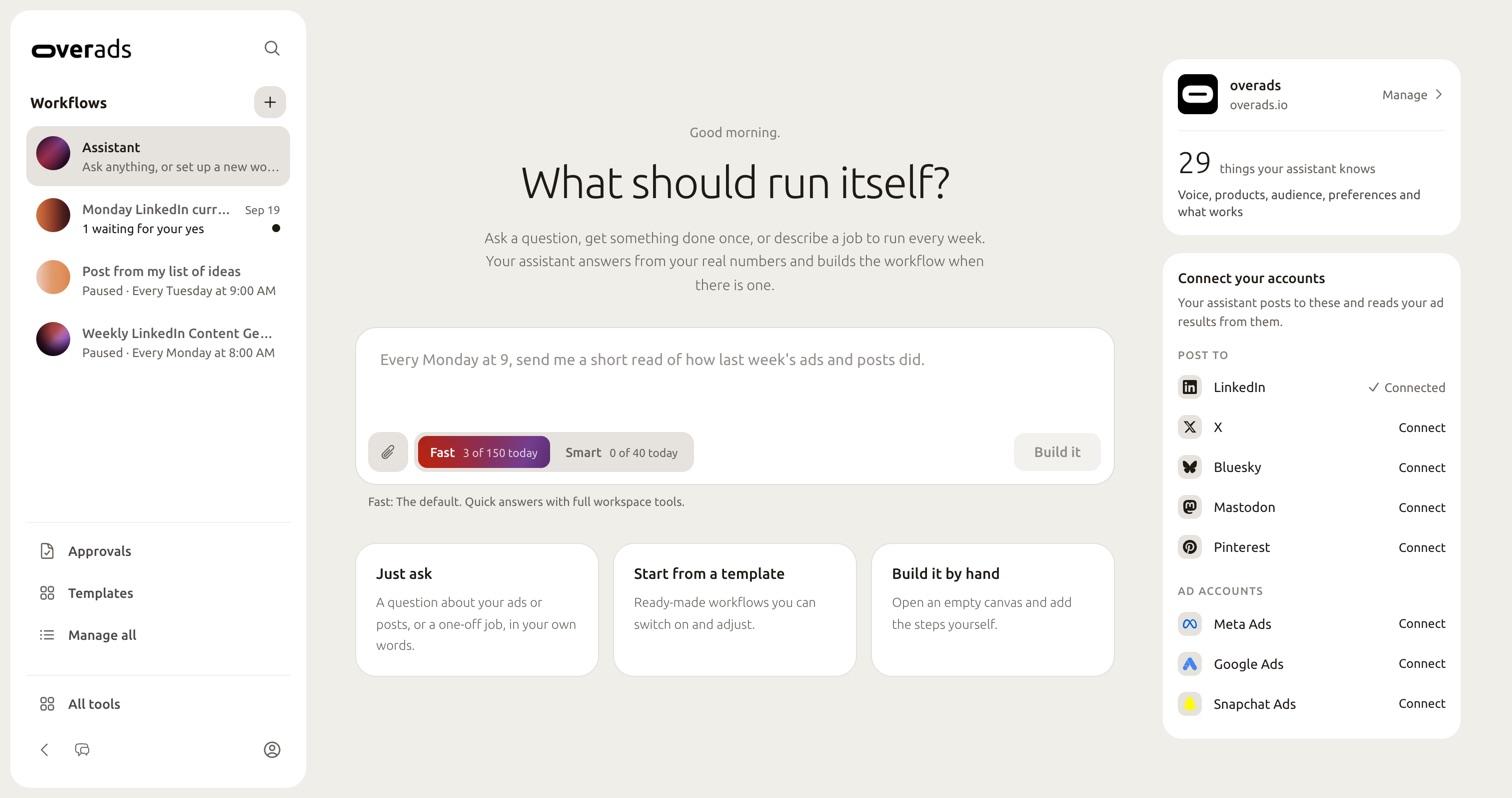
One overlap is worth knowing when reading GA4. An assistant such as Claude or ChatGPT can work inside an overads workspace through the overads MCP server. That work is a call to the server and not a page view, so it never appears in the AI Assistant channel of any GA4 property.
When another tool fits better: GA4 alone answers the click question. Search Console and Bing Webmaster Tools answer the impression and citation questions for Google and Copilot. A team that wants ad spend from several platforms in one report beside its analytics should look at cross-platform ad reporting tools, and a team that wants AI mentions counted needs a dedicated AI visibility tracker, which overads is not.
Frequently asked questions
Can I edit GA4's default AI Assistant channel?
No. Google's default channel group page says the default channel group cannot be edited. A custom channel group can be set as the property's primary channel group, and that one can be changed at any time.
Do custom channel groups appear in the BigQuery export?
No. Google's custom channel groups page says custom channel groups are not available in the BigQuery export schema, so an AI channel built this way exists only in the GA4 reports, explorations and audiences.
Does matching work on upper-case source values?
Google's regex page says Analytics regex is case sensitive by default, while its channel group pages say channel definitions are not case sensitive. The test in this post used lower-case hostnames only.
Sources
- What's new in Google Analytics: New AI Assistant traffic measurement. Google Analytics Help, May 13, 2026. Accessed Nov 17, 2026.
- Default channel group. Google Analytics Help. Accessed Nov 17, 2026.
- Custom channel groups. Google Analytics Help. Accessed Nov 17, 2026.
- About regular expressions (regex). Google Analytics Help. Accessed Nov 17, 2026.
- URL builders: Collect campaign data with custom URLs. Google Analytics Help. Accessed Nov 17, 2026.
- Known bot-traffic exclusion. Google Analytics Help. Accessed Nov 17, 2026.
- AI features and your website. Google Search Central, Dec 10, 2025. Accessed Nov 17, 2026.
- Search generative AI performance report. Search Console Help. Accessed Nov 17, 2026.
- Introducing AI Performance in Bing Webmaster Tools Public Preview. Bing Webmaster Blog, Feb 10, 2026. Accessed Nov 17, 2026.
- Overview of OpenAI Crawlers. OpenAI. Accessed Nov 17, 2026.
- Perplexity Crawlers. Perplexity. Accessed Nov 17, 2026.
Drafted with AI assistance, then checked against primary sources and the product itself by the overads team.
Keep reading
AI search · 11 min read
AI share of voice: what it is, how to calculate it, and why every tool reports a different number
AI share of voice is the share of brand mentions in AI answers that are yours. Five common formulas give 4% to 47% on the same five answers. The variants, how many answers a reading needs, and why tools disagree.
AI search · 9 min read
Should you opt out of AI Overviews? The Search Console control, explained
Google now lets any site leave AI Overviews and AI Mode from Search Console. What the control removes, how it differs from nosnippet and Google-Extended, why its report has no clicks, and how to test it on one folder first.
AI search · 6 min read
How to rank in ChatGPT: what actually gets a brand cited
ChatGPT answers a buying question with a short list of names and a handful of cited pages. Here is what we have seen decide whether a brand makes that list, and a routine for getting there without gaming anything.
Give AI assistants and searchers something to send people to
overads drafts posts, can hold them for your approval, and publishes them to Instagram, Facebook, LinkedIn, X, Bluesky, Mastodon and Pinterest.
Get started