

Meta ads learning phase: what it is, how long it lasts and what resets it
Meta ad sets usually leave the learning phase after about 50 results in the week after their last significant edit. What Learning limited means, which edits restart learning, and how to group ad sets.
TL;DR
- The Meta ads learning phase is the time after an ad set is created or significantly edited, while Meta's delivery system works out how to deliver it. Ads Manager shows it as Learning. An ad set usually leaves it after about 50 results in the week after its last significant edit.
- Learning limited means the ad set is unlikely to reach about 50 optimisation events in that week. Meta says it is not a penalty, and lists small audiences, low budgets, low bids, auction overlap and rare optimisation events as common causes.
- Any change to targeting, creative, optimisation event or bid strategy restarts learning, as do adding a new ad and a pause of seven days or more. Budget and bid amounts restart it only when the change is large.
- Meta's fix for slow learning is fewer, larger ad sets: combine similar ad sets, broaden the audience and use breakdowns for reporting instead of splitting audiences.
- Several Meta changes overads can make after a person confirms them are significant edits in Meta's list. overads does not read the learning status or warn before such an edit, so check Ads Manager first.
What the Meta ads learning phase is
The Meta ads learning phase is the period when Meta's delivery system is still learning how an ad set may deliver and perform. Meta's page about the learning phase says it starts when you create a new ad or ad set, and again when you make a significant edit to an existing one.
Meta describes the learning phase per ad set, not per campaign or per ad. In Meta Ads Manager, the Delivery column of an ad set reads Learning while it is in the phase.
Meta says ad sets in the learning phase are less stable and usually have a higher cost per action. Results from that period are not necessarily a guide to how the ad set will perform later. Meta also says the phase is necessary, and that an advertiser should not try to avoid it completely.
How many results end the Meta learning phase
A Meta ad set usually leaves the learning phase after about 50 results in the week after its last significant edit. Meta's learning phase page says the ad set exits as soon as it can deliver stably, and gives about 50 results in that week as the usual point.
Two details on the same page change how that figure is read.
- The count restarts at each significant edit. Results are counted from the last significant edit, not from the ad set's launch. An ad set that gets 30 results, is edited, and gets 30 more has not reached 50 in Meta's count.
- Shops ads have their own threshold. For Shops ads, the learning phase completes after at least 17 purchases through the website and 5 through Meta.
A result here is the ad set's optimisation event, the action it was set up to get. Meta's learning limited page talks about optimisation events for the same threshold. An ad set optimised for purchases needs about 50 purchases in the week; one optimised for landing page views needs about 50 landing page views.
To check progress, Meta's learning phase page says to add the Last significant edit column in Ads Manager and read the Results column next to it. The learning limited page adds Optimisation events as a column under Customise columns.
What Learning limited means
Learning limited is the Meta Ads Manager delivery status for an ad set that is unlikely to get about 50 optimisation events in the week after its last significant edit. Meta's page about learning limited says it is not a penalty. It means the budget is not being spent effectively, because the delivery system cannot optimise with the current setup.
Meta says the status can appear at any time after an ad set is created or significantly edited. For Shops ads, an ad set becomes learning limited when it has not reached 17 website purchases and 5 purchases through Meta after 7 days.
| Cause Meta names | Fix Meta suggests |
|---|---|
| Too many ad sets or ads running at once | Combine ad sets and campaigns |
| A small audience | Expand the audience |
| A low budget | Raise the budget |
| A low bid or cost control | Raise the bid or cost control |
| An optimisation event that happens rarely | Pick a more frequent event, for example add to basket instead of purchase |
| High auction overlap between your own ad sets | No separate fix named on this page |
When a low bid or cost control is the cause, Meta says a tooltip appears when you hover over the status. A learning limited ad set moves to Active once it receives enough optimisation events since its last significant edit.
Every fix in that table except combining is itself an edit. Meta lists a change of optimisation event and a change of targeting as significant edits, so each of those restarts the week's count.
Which edits restart the Meta learning phase
Only a significant edit sends a Meta ad set back into the learning phase. Meta's page on significant edits says every edit has some effect on delivery, but that only these restart learning.
| Edit | Restarts learning? | Note from Meta |
|---|---|---|
| Any change to targeting | Yes | Always significant |
| Any change to ad creative | Yes | Always significant |
| Any change to the optimisation event | Yes | Always significant |
| Adding a new ad to the ad set | Yes | Always significant |
| Changing the bid strategy | Yes | Under Advantage+ campaign budget, it can restart several ad sets |
| Pausing the ad set for 7 days or longer | Yes, on unpause | Learning restarts when the ad set is switched back on |
| Changing the disclaimer on an ad about social issues, elections or politics | Yes | Listed in Meta's questions on the same page |
| Budget amount | Depends on the size | USD 100 to 101 is not likely to; USD 100 to 1,000 may |
| Ad set spending limit amount | Depends on the size | No figure given |
| Bid control, cost per result goal or ROAS goal amount | Depends on the size | No figure given |
Meta's learning phase page adds one more rule: frequent budget changes can also send an ad set back into learning. It advises a budget large enough to get the results needed, set once, instead of small, repeated adjustments.
Advantage+ campaign budget, where the budget sits on the campaign, has its own answers on the same page, listed below. How it differs from ad set budgets is set out in the comparison of campaign budget vs ad set budget.
- Learning takes the same time as it does with ad set budgets.
- Meta moving budget between ad sets does not restart learning.
- A significant edit made to one ad set does not restart the others in the campaign.
- Adding a new ad set does not restart the existing ones.
- Changing the campaign budget or the campaign bid strategy might restart several ad sets at once.
How to group Meta ad sets so they exit learning
Meta's advice for ad sets that stay in learning is to run fewer, larger ad sets. Its page on combining ad sets and campaigns says that when too many ad sets run at once, each gets fewer chances to learn and fewer results. They spend longer in the learning phase, and more budget goes out before delivery is optimised.
Meta's example is three ad sets with the same objective and creative, one each for people interested in dogs, dog toys and dog collars. Splitting them divides the audience three ways. Meta suggests one ad set with all three interests and a broader audience.
The page about managing ad volume gives the same reasoning for ads: when an advertiser runs too many ads, each delivers less often, so fewer ads exit learning. Its suggestions:
- Combine ad sets split only for reporting, and read each audience through breakdowns such as age, gender, country or region.
- Combine ad sets split by small geographic areas into larger ones.
- Combine ad sets split by placement, and use Advantage+ placements with asset customisation.
- Combine ad sets split by language, and set several languages in one ad set.
- Use fewer ads per ad set with more creative inside each: one ad can hold up to ten creative assets.
The trade is reporting detail for learning speed. A team that needs a separate result per audience can still read it through breakdowns, which Meta recommends over separate ad sets.
Reading the learning phase through the Meta Marketing API
The Meta Marketing API reports an ad set's learning phase in a field called learning_stage_info. The Ad Set reference describes it as information on whether the delivery system is still learning for the ad set.
The Ad Campaign Learning Stage Info reference, Graph API v27.0, lists its fields:
| Field | What Meta's reference says |
|---|---|
| status | LEARNING (still learning), SUCCESS (exited the learning phase) or FAIL (not generating enough results to exit) |
| conversions | Conversions since the last significant edit during the learning phase; zero once the ad set has exited |
| last_sig_edit_ts | Timestamp of the last significant edit that sent the ad set back into learning |
| attribution_windows | The number of days between a view or click on the ad and the action |
| dynamic_lp_status, dynamic_lp_conversions_threshold, dynamic_lp_days_threshold | A dynamic learning phase status, conversions threshold and days to exit, with no further explanation |
The field is read-only: the reference says it cannot be created, updated or deleted. A FAIL status is the API's form of what Ads Manager shows as Learning limited, going by the two descriptions.
Which overads changes count as significant edits
Several Meta changes that overads can make are significant edits on Meta's list. This section maps them, from the overads code as it stood on November 25, 2026 and from Meta's significant edits page. It is not based on a test.
Meta and Google ad changes run after you approve them; X and Snapchat connect read-only, so overads proposes and a person applies. On Meta that covers pausing and resuming campaigns, ad sets and ads, budget changes, launching ads and audiences, and automation rules; on Google, pausing and resuming a campaign and changing its daily budget. Each change is confirmed by a person first.
| Change made from overads | What it does on Meta | Restarts learning? |
|---|---|---|
| A new creative for an ad | Meta cannot change a creative in place, so overads adds a new ad with the new creative to the same ad set | Yes: adding a new ad to an ad set is significant |
| An audience edit on an ad set | Changes the ad set's locations, age, gender or custom audiences | Yes: any change to targeting is significant |
| A budget change | Sets a new daily or lifetime budget on a campaign or ad set | Depends on the size; a campaign budget change can restart several ad sets |
| A budget raised or lowered by a percentage, from an automation rule | Reads the current budget and moves it by the percentage | Depends on the size; repeated changes can also restart it |
| Pausing an ad set | Sets its status to paused | Only if it stays paused for 7 days or longer, when it is switched back on |
| Launching a new ad | Creates a new campaign, ad set and ad, all paused | A new ad set starts its own learning phase once it runs |
The practical reading: an ad set close to 50 results in its week will start the count again after a new creative or an audience edit, whether the change is made in Ads Manager or from overads. Checking the Delivery column and the Last significant edit column in Ads Manager before confirming such a change avoids restarting an ad set that is about to leave learning.
Where overads fits
overads fits a team that reads Meta ad sets next to its other ad accounts and wants each Meta change to wait for a person. It does not replace Ads Manager for watching the learning phase.
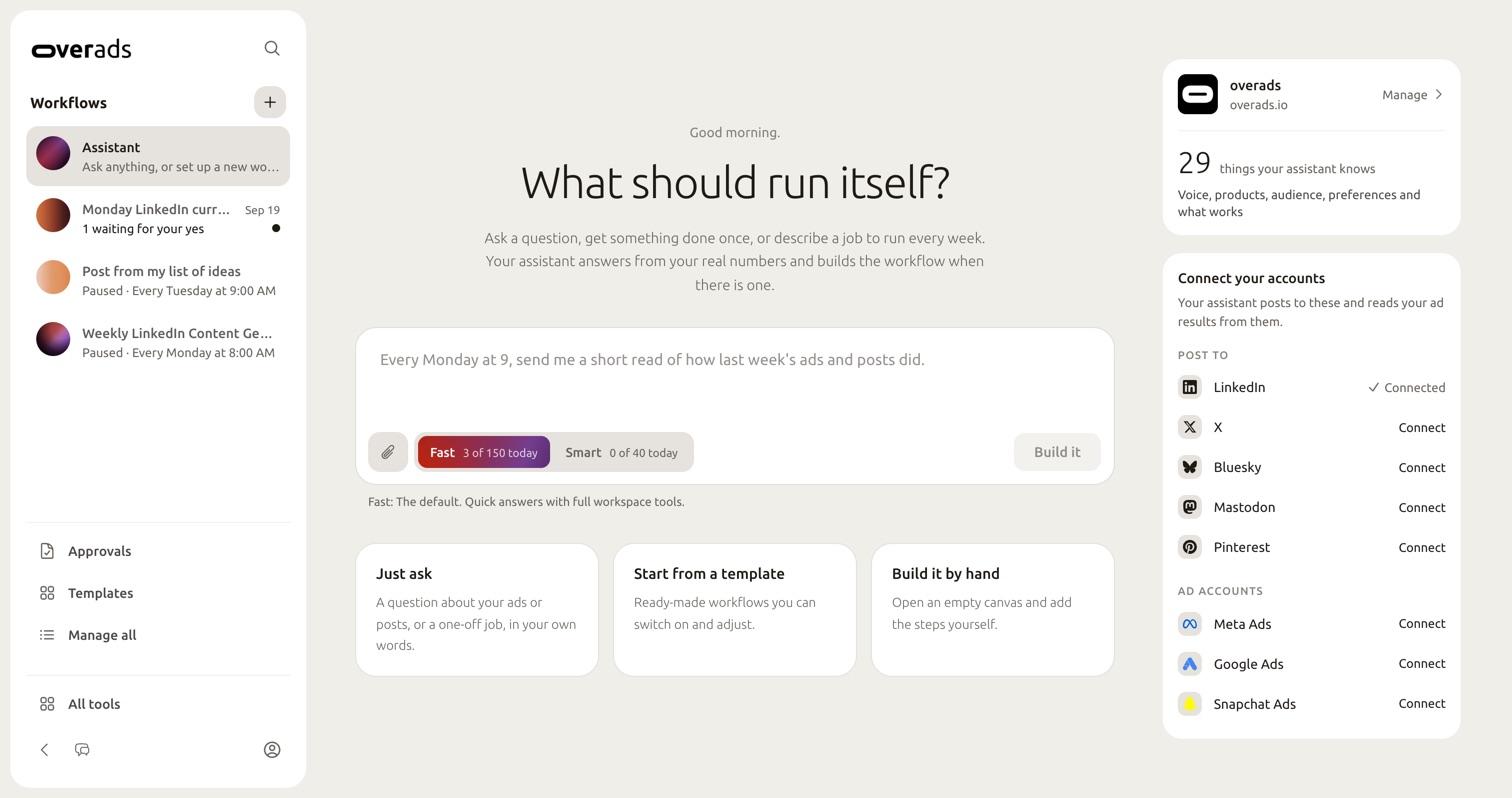
What overads does not do, read from the code on November 25, 2026:
- It does not read
learning_stage_info, so it does not show whether a Meta ad set is in Learning or Learning limited. - It does not warn that a change it is about to make is a significant edit.
- It does not combine ad sets or campaigns.
- It does not change an ad set's optimisation event or bid strategy.
When another route fits better: an advertiser on one Meta account already has the learning status, the Last significant edit column and Meta's combine recommendations in Ads Manager, and needs nothing else to manage the phase. Ad sets that slow down after weeks of stable delivery may have a different problem, covered in the guide to Meta ads creative fatigue. For teams, the Meta ads for DTC operators page and the Meta ads reporting for agencies page describe what overads reads from Meta, and Madgicx alternatives compared covers Meta ad tools that automate more. How a change waits for approval inside an overads workflow is in the workflows guide.
Frequently asked questions
What size of budget change restarts the learning phase?
Meta gives no percentage. Its significant edits page says a change from USD 100 to USD 101 is not likely to restart learning, while a change from USD 100 to USD 1,000 may.
Should an advertiser try to avoid the learning phase?
No. Meta's learning phase page says the phase is necessary for the delivery system to optimise ads, and that testing new creative and strategies matters for performance over time. Its advice is to avoid unnecessary edits, not all edits.
What is the dynamic learning phase in the Marketing API?
Unknown from Meta's public pages. The API reference for an ad set's learning stage lists a dynamic learning phase status, a conversions threshold and a days threshold, with one-line descriptions and no explanation of when they apply.
Sources
- About the learning phase for ad sets in Meta Ads Manager. Meta Business Help Centre. Accessed Nov 25, 2026.
- Significant edits and learning phase. Meta Business Help Centre. Accessed Nov 25, 2026.
- About learning limited. Meta Business Help Centre. Accessed Nov 25, 2026.
- Combine ad sets and campaigns in Meta Ads Manager to reduce audience fragmentation. Meta Business Help Centre. Accessed Nov 25, 2026.
- About managing ad volume. Meta Business Help Centre. Accessed Nov 25, 2026.
- Marketing API reference: Ad Set. Meta for Developers. Accessed Nov 25, 2026.
- Graph API reference v27.0: Ad Campaign Learning Stage Info. Meta for Developers. Accessed Nov 25, 2026.
Drafted with AI assistance, then checked against primary sources and the product itself by the overads team.
Keep reading
Paid media · 13 min read
Meta ads creative fatigue: how to spot it and what Meta's statuses mean
Meta flags a worn-out creative as Creative limited or Creative fatigue, split at twice your past cost per result, and only on ad sets with one creative. What the statuses mean, the signals to read without them, and what a refresh costs.
Paid media · 13 min read
ads_management vs ads_read: why many ad tools can read your campaigns but not change them
ads_read lets a tool report on Meta ad accounts; ads_management lets it change them. One app declined on July 28 and approved on November 2, 2026, what changed between, what the permission lets a tool do, and how to check your connection.
Paid media · 13 min read
Cross-platform ad metrics normalization: what to fix before adding Meta, Google and Snapchat
Meta, Google and Snapchat each count spend, conversions, reach and clicks their own way, in each account's own currency. What to normalize before adding them up, which figures never add, and a worked week in two currencies.
See every Meta ad set next to your other ad accounts
Connect a Meta ad account to read campaigns, ad sets and ads beside Google and your other channels. Where Meta changes are switched on, a change goes to Meta only after a person confirms it.
Get started