

Meta ads creative fatigue: how to spot it and what Meta's statuses mean
Meta flags a worn-out creative as Creative limited or Creative fatigue, split at twice your past cost per result, and only on ad sets with one creative. What the statuses mean, the signals to read without them, and what a refresh costs.
TL;DR
- Meta ads creative fatigue occurs when an audience has seen the same creative too many times, so people engage less and cost per result rises. Meta Ads Manager flags it in the Delivery column as Creative limited or Creative fatigue.
- The line between the two statuses is cost per result. Above your past ads but under twice as much is Creative limited. Twice as much or more is Creative fatigue.
- Only ad sets with one creative can show the status. Advantage+ catalogue ads, dynamic creative and Advantage+ app campaigns are excluded, so most accounts also need to read frequency and cost per result themselves.
- Meta's help pages give no frequency number at which fatigue starts. They say to watch frequency together with results and the ad relevance diagnostics.
- Meta's first recommendation is a new ad with a materially different image or video, with the original left running. A new creative is a significant edit, so the ad set re-enters the learning phase.
What creative fatigue is on Meta ads
Creative fatigue on Meta ads is the drop in response that follows when an audience has seen the same creative too many times. Meta's help page on creative fatigue recommendations defines it in those terms and names the consequence: people may be less likely to engage with the ad, which can lead to a higher cost per result.
Creative fatigue is about the creative, meaning the image or the video, and not about the ad as a line in Meta Ads Manager. Meta says it considers all recent exposures of the ad's image or video, including those from other campaigns from your Page. The same picture in three campaigns is one creative wearing out three times as fast, not three fresh ads.
Creative fatigue is also not the only reason a cost per result rises. Meta documents several others, and they need different fixes. Telling them apart is most of the work, and it is covered below.
How Meta flags creative fatigue in Ads Manager
Meta Ads Manager flags creative fatigue with two statuses in the Delivery column of an ad set or ad: Creative limited and Creative fatigue. Both mean the audience has seen the same ad too many times. The difference between them is how far cost per result has moved against the ads you ran in the past.
| Question | What Meta's help page says |
|---|---|
| Where does it appear? | In the Delivery column, as Creative limited or Creative fatigue, on an ad set or an ad |
| What triggers Creative limited? | Repeat exposure, with cost per result above past ads but less than twice as much |
| What triggers Creative fatigue? | Repeat exposure, with cost per result twice as much as past ads, or more |
| What counts as exposure? | All recent exposures of the image or video, including other campaigns from the same Page |
| Is there a warning before launch? | Yes, when fatigue may occur in the first 7 days of the campaign |
| Which ad sets are eligible? | Ad sets with one creative. Not Advantage+ catalogue ads, dynamic creative or Advantage+ app campaigns |
| Any other limit? | Not available with the sales objective before an ad set is active |
Two details in that table change how much weight the status deserves. First, the comparison is with your own past ads, not with a market benchmark. Meta does not say on that page which past ads or which period it uses. An account whose earlier ads were unusually cheap will see the status sooner than one whose earlier ads were expensive.
Second, eligibility is narrow. The status exists only for ad sets with one creative. An ad set holding four ads, a catalogue campaign or a dynamic creative ad set shows no fatigue status at all, whatever its audience has seen. The absence of the label is therefore not evidence that the creative is fine.
Frequency, CTR and cost per result as fatigue signals
Frequency, click-through rate and cost per result are the three figures an advertiser reads to spot creative fatigue on Meta when no status is shown. Meta's Frequency page defines frequency as the average number of times each Meta account saw your ad, calculated as impressions divided by reach. The page marks the metric as estimated and as calculated from sampled data.
Meta publishes no frequency number at which fatigue begins. The Frequency page says frequency may average 1 to 2 per ad set or may be much higher, depending on budget, audience size and schedule. Its advice is relational: if performance begins to drop as frequency rises, the audience may be experiencing ad fatigue, and it may be wise to change the creative or the targeting. None of the nine Meta pages read for this post gives a threshold such as 3 or 5. A frequency figure on its own is not a verdict.
Meta's ad relevance diagnostics are the closest thing to a published read on whether the creative itself is the problem. There are three: quality ranking, engagement rate ranking and conversion rate ranking. Each compares the ad with ads competing for the same audience over the date range you select. They are not available for ads with fewer than 500 impressions, and Meta says they are not inputs into the ad auction.
Meta's guide on how to use the diagnostics reads a below-average engagement rate ranking, with the other two at average or above, as an ad that is not spurring interest. That is the pattern a tired creative tends to show. The same guide says to use the diagnostics on under-performing ads only, and that a high-performing ad with below-average rankings is fine.
Click-through rate is the signal most guides lead with, and Meta gives it no threshold either. Read it the way Meta reads frequency: as a trend on one ad, over a full week or more, beside cost per result for the optimisation event you chose.
Creative fatigue vs audience saturation vs delivery changes
Creative fatigue, audience saturation and ordinary delivery changes all show up as a rising cost per result on Meta, and Meta's help pages describe each one separately. A new creative fixes only the first.
| Cause | What Meta says | What points to it | What to try |
|---|---|---|---|
| Creative fatigue | The audience has seen the same creative too many times | Frequency rising while results fall on one image or video. Creative limited or Creative fatigue where eligible | A new, materially different ad |
| Cheapest opportunities used up | The delivery system seeks the highest volume opportunities first, then may move to more expensive ones | Cost climbs across the campaign's schedule, on every ad in the ad set | A larger audience, or accept the cost |
| Auction overlap | Ads from one advertiser with overlapping audiences enter the same auction, and only one competes | Ad sets that underspend or stay in the learning phase | Combine or turn off overlapping ad sets |
| Learning phase | Performance is less stable and cost per action is usually worse while the system explores | Delivery reads Learning. A recent significant edit | Wait for about 50 results before judging |
| Normal fluctuation | Spend may run up to 75% over the daily budget on some days and under on others | A bad day or hour inside an ordinary week | Read a full week before acting |
The second row is the one most often mistaken for fatigue. Meta's page on fluctuations in ad performance answers the question of why prices increase over time: the delivery system takes the lower cost opportunities first, and when they run out it may move on to more expensive ones, depending on the bid strategy. That is saturation of the audience, and it happens to a fresh creative as well as an old one. Swapping the image does not bring the cheap impressions back.
Meta's page on auction overlap describes the third row. When two or more ads from the same advertiser enter one auction, Meta enters only the ad with the highest total value. The others do not compete, which can stop an ad set from spending its budget or from leaving the learning phase. Meta notes that separate ad accounts may not avoid it.
The same fluctuations page gives two reading rules that protect against a false alarm. Look at overall results for the ad set or campaign over a full week, and be careful with breakdowns such as hour of day, because swings there average out. It also says a daily budget is an average: on a weekly basis Meta will not spend more than seven times the daily budget.
How to check an ad for creative fatigue, in order
Checking a Meta ad for creative fatigue means confirming two things together, repeat exposure and falling results, and then excluding the causes that imitate them. The order below follows Meta's own pages.
- Read the Delivery column. If the ad set has one creative, Creative limited or Creative fatigue is Meta's own verdict. If it has several, there will be no status and the next steps carry the weight.
- Put frequency beside cost per result. Use the same date range for both, at the ad level, for a week or more. Fatigue is frequency rising while results fall.
- Add the three ad relevance diagnostics. They are in the Performance column preset. A below-average engagement rate ranking on an ad that used to work supports the fatigue reading.
- Rule out the other causes. Check whether the ad set is in the learning phase, whether another of your ad sets reaches the same people, and whether every ad in the ad set got more expensive at once.
- Add a new ad and keep the old one running. Meta asks for an image or video that is materially different from the original, and notes that keeping the original active may maximise results.
Meta lists two other recommendations beside a new ad. One is to expand the audience, so the ad reaches people who have not seen it too much yet. The other is Advantage+ creative, which makes variations from a single image or video. Meta says Advantage+ creative is available only for campaigns using the traffic or sales objectives with a website destination.
How often to refresh Meta ad creative
Meta publishes no schedule for refreshing ad creative, and the pages read for this post point toward refreshing on a signal, not on a calendar. The reason is that every refresh has a cost that Meta documents.
Meta's list of significant edits includes any change to ad creative and adding a new ad to an ad set. A significant edit sends the ad set back into the learning phase. Meta's learning phase page says ad sets in that phase are less stable and usually have a higher cost per action, and that they usually leave it after about 50 results in the week after the last significant edit. The same page says to edit only when you have reason to believe the edit should improve performance.
So a weekly swap by habit can keep an ad set permanently in the learning phase, which produces the unstable costs the swap was meant to cure. An ad set that gets 20 results a week never collects the 50 it needs between weekly edits. That arithmetic is ours, from Meta's figure.
Volume has a cost too. Meta's page on managing ad volume says that when an advertiser runs too many ads at once, each ad delivers less often and fewer ads leave the learning phase. It suggests fewer ads per ad set with diverse creative inside each, and notes that one ad can contain up to ten creative assets.
A workable rule from those pages: prepare replacement creative ahead of need, and add it when the checks in the previous section point to fatigue. How long a creative lasts depends on budget and audience size, which is why Meta gives no number.
Where overads fits
overads fits a team that wants each ad compared with its own earlier period across connected ad accounts, without opening every account in turn. For brands it is described on Meta ads for DTC operators, and for client work on Meta ads for agencies.
overads marks an ad Stale by a rule of its own, read from the overads code on November 20, 2026. An ad is marked Stale when its return on ad spend in the selected period is below 80% of its return in the period of the same length just before it. The ad must have at least 500 impressions and some spend in the selected period, and the period can be up to 90 days. The mark sits beside the ad's verdict in the Creatives view, which opens from the creative verdicts strip on the Ad accounts page.
That rule is a different test from Meta's. Meta's statuses combine repeat exposure with cost per result against past ads. The overads mark compares one ad's return with its own previous period and knows nothing about how often people saw it. An ad can carry one label without the other.
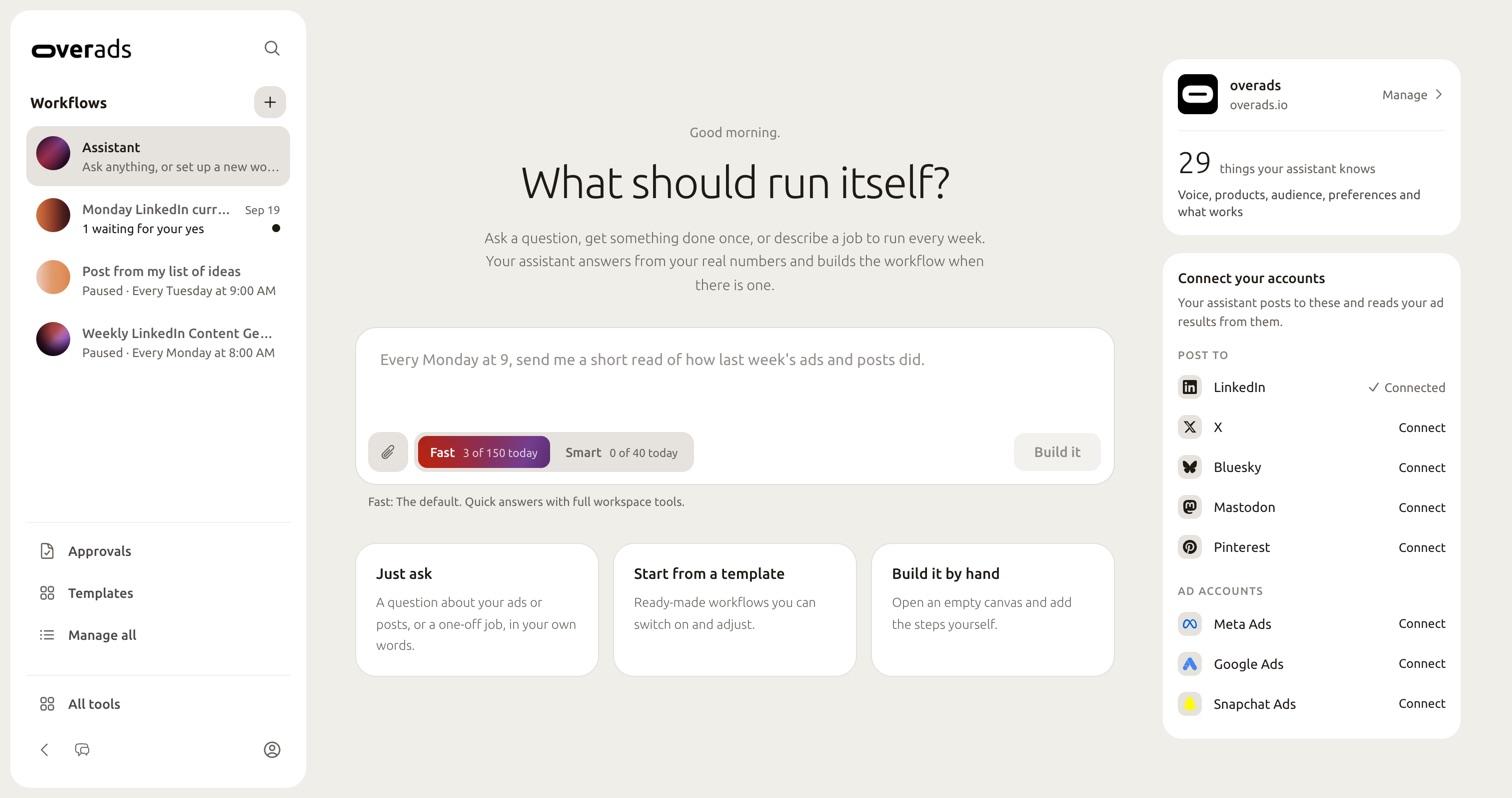
What overads does not do, read from the code on November 20, 2026:
- It does not read frequency or reach from Meta, so it cannot show the frequency trend this guide relies on.
- It does not read Meta's Creative limited or Creative fatigue statuses, or the ad relevance diagnostics. Those are in Meta Ads Manager.
- The Stale mark needs a return figure in both periods. An ad with no purchase value reported, such as a lead ad, is never marked Stale.
- The Creatives view lists verdicts for the 50 ads with the most spend in the selected account and period.
- Meta, Google and X sync every campaign, ad set and ad; Snapchat shows spend totals only. An account that sends spend totals only gets no ad verdicts.
On changes: Meta and Google ad changes run after you approve them; X and Snapchat connect read-only, so overads proposes and a person applies. On Meta that covers pausing and resuming campaigns, ad sets and ads, budget changes, launching ads and audiences, and automation rules; on Google, pausing and resuming a campaign and changing its daily budget. Each change is confirmed by a person first. How that access was granted is in ads_management vs ads_read.
When another route fits better: an advertiser with one Meta account and single-creative ad sets already has Meta's own status in the Delivery column and needs nothing else to see it. A team that wants rules that act on frequency needs a tool that reads frequency, which overads does not. The wider field of Meta ad tools is in Madgicx alternatives compared.
Frequently asked questions
Is ad fatigue the same as creative fatigue?
Meta uses both terms and does not define a difference. Its Frequency page says an audience may be experiencing ad fatigue when performance drops as frequency rises. Its recommendations page calls the same pattern creative fatigue and names the two Delivery statuses after it.
Does a high opportunity score mean an account has no creative fatigue?
No. Meta delivers creative fatigue recommendations through opportunity score, and the same page says the score does not reflect actual or future performance and does not guarantee it.
Does running the same image in a second campaign reset the count?
No. Meta says it considers all recent exposures of the ad's image or video, including those from other campaigns from your Page.
Sources
- About creative fatigue recommendations in Meta Ads Manager. Meta Business Help Centre. Accessed Nov 20, 2026.
- Frequency. Meta Business Help Centre. Accessed Nov 20, 2026.
- About ad relevance diagnostics. Meta Business Help Centre. Accessed Nov 20, 2026.
- How to use ad relevance diagnostics. Meta Business Help Centre. Accessed Nov 20, 2026.
- Understand fluctuations in ad performance. Meta Business Help Centre. Accessed Nov 20, 2026.
- Understand auction overlap. Meta Business Help Centre. Accessed Nov 20, 2026.
- About the learning phase for ad sets in Meta Ads Manager. Meta Business Help Centre. Accessed Nov 20, 2026.
- Significant edits and learning phase. Meta Business Help Centre. Accessed Nov 20, 2026.
- About managing ad volume. Meta Business Help Centre. Accessed Nov 20, 2026.
Drafted with AI assistance, then checked against primary sources and the product itself by the overads team.
Keep reading
Paid media · 13 min read
ads_management vs ads_read: why many ad tools can read your campaigns but not change them
ads_read lets a tool report on Meta ad accounts; ads_management lets it change them. One app declined on July 28 and approved on November 2, 2026, what changed between, what the permission lets a tool do, and how to check your connection.
Paid media · 13 min read
Cross-platform ad metrics normalization: what to fix before adding Meta, Google and Snapchat
Meta, Google and Snapchat each count spend, conversions, reach and clicks their own way, in each account's own currency. What to normalize before adding them up, which figures never add, and a worked week in two currencies.
Paid media · 12 min read
Can you see a competitor's ad spend? What each ad library shows in 2026
Meta's, Google's and LinkedIn's ad libraries publish no commercial spend. Meta shows run dates, platforms and EU reach; Google a last-shown date and format; LinkedIn an impressions range for EU-targeted ads. Spend elsewhere is an estimate.
See which ads are slipping, account by account
Connect an ad account and overads compares each ad with its own previous period, then waits for a person before anything changes.
Get started