

Best marketing automation tools 2027: ten platforms, where automation starts and what each one meters
Ten marketing automation platforms read on their own pricing pages on November 18, 2026, from HubSpot and Klaviyo to Zapier and n8n: what each automates, the tier where automation really starts, and what the bill counts.
TL;DR
- The best marketing automation tools for 2027 depend on the job: HubSpot, ActiveCampaign, Mailchimp or Brevo for email and CRM flows, Klaviyo for ecommerce, Customer.io for product messaging, Zapier, n8n or Make to connect apps, and overads for social posts and ad changes.
- Automation often starts above the entry tier. Read on November 18, 2026: Brevo adds it on Standard at $18 a month, not Starter at $9; Mailchimp caps Essentials at 4 flow steps; HubSpot Starter allows 10 automated email actions and keeps full workflows for Professional.
- Each bill counts something different: contacts or profiles plus email sends (HubSpot, ActiveCampaign, Mailchimp, Klaviyo, Customer.io), emails (Brevo), tasks (Zapier), workflow runs (n8n) or credits (Make). AI use is usually a second meter.
- Eight of the nine pricing pages read now name an AI agent, assistant or builder. Before comparing price, ask what it may do without a person and which limit holds it.






What a marketing automation tool is
A marketing automation tool is software that runs a marketing task when a trigger fires, without a person starting it each time. The trigger can be a signup, a purchase, a date, a row in a sheet or a metric crossing a line. The task can be an email, a text message, a CRM update, a social post or a change to an ad.
Marketing automation platforms going into 2027 fall into four kinds, and the kind decides what the bill counts:
- Email and CRM automation sends messages to contacts as they move through a funnel. It is billed by contacts and sends.
- Ecommerce and product messaging reacts to orders and in-app events. It is billed by profiles and messages.
- Workflow automation connects apps that do not talk to each other. It is billed by tasks, runs or credits.
- Agents draft and act across channels from a plain description of the job. They are billed by AI credits or run caps.
This comparison is not a ranking. Ten tools were chosen because each vendor publishes plans on its own site and each fits one of the four kinds. Every vendor cell comes from that vendor's page, read on November 18, 2026. No tool was signed up for or tested here. For AI tools sorted by job, such as writing and design, see our list of the best AI marketing tools.
The ten marketing automation tools at a glance
The ten marketing automation tools below differ most in what they automate and what the bill counts. The fourth column is the meter: the number that grows as the business grows, as each vendor's pricing page states it.
| Tool | Kind | What it automates | What the bill counts |
|---|---|---|---|
| HubSpot Marketing Hub | Email and CRM | Email, forms, ads audiences and CRM workflows | Seats, marketing contacts and HubSpot Credits for agents |
| ActiveCampaign | Email and CRM | Multi-step email automations; SMS and WhatsApp as channels | Contacts, email sends at 10 to 15 times the contact limit, AI credits |
| Mailchimp | Email and CRM | Email campaigns and automation flows | Contacts and monthly sends at 10 to 15 times contacts |
| Brevo | Email and CRM | Email, SMS and multi-step workflows | Emails per month; SMS credits sold separately |
| Klaviyo | Ecommerce | Email campaigns and flows; SMS as an add-on | Active profiles, emails, mobile message spend, AI agent usage |
| Customer.io | Product messaging | Email, push, in-app and webhook journeys | Profiles, emails and AI credits |
| Zapier | Workflow | Steps across more than 9,000 apps | Tasks: each successful action step |
| n8n | Workflow | Workflows and agents, hosted or self-hosted | Workflow executions, whatever the number of steps |
| Make | Workflow | Scenarios built from app modules | Credits: most module actions use 1 |
| overads | Agent | Social posts, reports and ad changes on Meta and Google | A daily workflow run cap and a monthly AI budget, set by the plan |
Where automation starts on each price list
Automation starts above the entry tier on several of these price lists, so the lowest advertised price is not always the price of automating anything. The table shows the entry tier each page listed on November 18, 2026, and what that tier automates. Prices are in US dollars unless the page showed another currency.
| Tool | Entry tier on the page | Automation in that tier | The step up |
|---|---|---|---|
| HubSpot | Free tools; Starter from $7 a seat a month for new customers, beside a $20 list price | Free: 1 automated email action. Starter: up to 10 | Professional from $800 a month: up to 300 workflows |
| ActiveCampaign | Starter from $15 a month, billed yearly, for 1,000 contacts | Multi-step automation, 5 actions per automation | Plus from $49: unlimited actions, cross-channel |
| Mailchimp | Free up to 250 contacts; paid price not quoted, the page showed a 50% offer | Free: flows not included. Essentials: up to 4 flow steps | Standard: up to 200 flows |
| Brevo | Starter at $9 a month, from 5,000 emails | None listed on Starter | Standard at $18: unlimited multi-step workflows |
| Klaviyo | No-cost tier to 250 active profiles; Email at $20 a month for 500 | Campaigns and flows | Marketing plan from $25; SMS is an add-on |
| Customer.io | Essentials from $100 a month for 5,000 profiles | Visual workflow builder, 1 million emails a month | Premium from $1,000 a month, billed yearly |
| Zapier | A $0 tier with 100 tasks a month | Two-step Zaps only | Professional from $19.99 a month on yearly billing: multi-step Zaps |
| n8n | Starter at 20 euros a month, billed annually; self-hosted Community Edition | 2,500 executions a month with unlimited steps | Pro at 50 euros: 10,000 executions |
| Make | Free with 1,000 credits a month | Scenarios, within the credits | Paid plan prices were not readable on the page today |
| overads | One paid plan; this blog does not quote our own prices | Workflows that ask for approval first | See the pricing page |
Three patterns stand out. Brevo's lowest paid tier sends email but lists no automation. Mailchimp and HubSpot include automation low down but cap its length. Zapier's no-cost tier limits a workflow to two steps, which rules out most marketing chains.
Email and CRM automation: HubSpot, ActiveCampaign, Mailchimp and Brevo
HubSpot, ActiveCampaign, Mailchimp and Brevo all automate email to a contact list, and they differ in how much CRM sits underneath. HubSpot Marketing Hub is the one built on a full CRM. Its pricing page lists Starter with 1,000 marketing contacts and 500 HubSpot Credits, and Professional from $800 a month with 3 core seats, 2,000 marketing contacts and up to 300 workflows. The same page says Professional carries a required one-time onboarding fee of $3,000. HubSpot's automation page says basic automation features are available at no cost.
ActiveCampaign puts multi-step automation in every plan. Its pricing page lists Starter from $15 a month, billed yearly, for 1,000 contacts and 10,000 email sends, with 5 actions per automation. Plus, from $49, lifts that cap and adds cross-channel marketing. Every plan lists 500 credits for its AI features, and the price scales with the contact list.
Mailchimp's pricing page lists a Free tier for under 250 contacts, capped at 500 sends a month, with automation flows not included. Essentials allows up to 4 flow steps, and Standard and Premium allow up to 200 flows. The page says overages apply on paid plans when a contact or send limit is passed. It showed a 50% offer for 12 months on the day it was read, so no price is quoted here.
Brevo bills by emails sent, not by contacts. Its pricing page lists Starter at $9 a month from 5,000 emails and Standard at $18, where marketing automation appears as unlimited multi-step workflows. Professional, at $499 a month from 150,000 emails, adds WhatsApp, popups and push. SMS credits are sold separately.
Ecommerce and product messaging: Klaviyo and Customer.io
Klaviyo and Customer.io automate messages from behaviour, not from a calendar: Klaviyo from store events, Customer.io from product events. Klaviyo's pricing page lists a no-cost tier for up to 250 active profiles and 500 emails a month, then an Email plan at $20 a month for 500 active profiles and 5,000 emails. The plan comparison lists campaigns and flows under email marketing. SMS and MMS are an add-on on the paid plans, and its AI agent, Composer, comes with $10 of usage a month before it becomes an add-on.
Customer.io starts higher and includes more volume. Its pricing page lists Essentials from $100 a month, billed monthly, for 5,000 profiles and 1 million emails a month, with a visual workflow builder and unlimited seats. Extra profiles are $0.009 each and extra emails $0.12 per 1,000. Premium starts at $1,000 a month, billed yearly.
Workflow automation: Zapier, n8n and Make
Zapier, n8n and Make connect apps to each other, and each counts a different unit. Zapier's pricing page says a task is used each time a Zap completes an action, that triggers do not count, and that one MCP tool call uses two tasks. Its Free tier has 100 tasks a month, and Professional starts from $19.99 a month on yearly billing. At the task limit, an account moves to pay-per-task billing unless that is turned off.
n8n counts a whole workflow run as one execution. Its pricing page lists Starter at 20 euros a month, billed annually, with 2,500 executions, and Pro at 50 euros with 10,000. A self-hosted Community Edition is published on GitHub. Make's pricing page says credits are its billing unit, that most module actions use 1 credit, that its Free tier has 1,000 credits a month, and that unused credits expire at the end of the term.
What one social post costs in each unit is worked through in our comparison of n8n, Zapier and Make for social media. Each of the three can call overads to publish, per the Zapier guide in our docs.
AI agents inside marketing automation platforms
AI agents or AI features now appear on eight of the nine vendor pricing pages read for this comparison, often with their own meter. The pages say the following, and no more is claimed here:
- HubSpot lists customer, data, prospecting and campaign agents, says credits are used when features take action, and says you decide how much each feature can spend.
- ActiveCampaign lists AI actions, scheduled tasks and proactive drafts as limited on every plan.
- Klaviyo describes Composer as an agent that plans a calendar, builds campaigns and audits flows.
- Customer.io lists an AI Agent in beta, with 1 weekly routine on Essentials and 5 daily routines on Premium.
- Mailchimp lists generative AI features on Standard and Premium, and Brevo lists an AI content generator on Starter.
- Zapier lists Agents with 400 activities a month on its no-cost Agents tier, and an approval requests feature in beta.
- n8n lists human approval for tool calls on its Starter, Pro and Enterprise plans.
Make's pricing page mentions AI only as a reason some actions use more credits. None of these pages alone says exactly which actions an agent takes without a person. That is the question to put to a vendor, and our human in the loop guide covers where a person should stay.
How to choose a marketing automation tool for 2027
Choosing a marketing automation tool for 2027 takes five checks, in this order, because the first three rule tools out before price does:
- Name what you are automating. A contact funnel needs email and CRM automation. A store needs order events. A chain across apps needs a workflow tool. Social posts and ad changes need a tool that connects to those accounts.
- Find the tier where automation starts, and its cap. Count the steps your longest sequence needs before trusting an entry price.
- Find the meter and project it. Multiply contacts, sends, tasks or runs by a busy month, not an average one, and read what happens at the limit: overage billing, a pause or an automatic upgrade.
- Ask what acts without a person. For each agent or flow, find the limit that holds it: an approval step, a spend control or a daily cap.
- Then compare price, on the vendor's own page, on the day you buy. Limited-time and new-customer offers were on several pages read for this article.
Marketing automation for small business usually means the first and second kind plus one workflow tool. A welcome series fits inside the capped tiers above; a long branching funnel does not.
Where overads fits
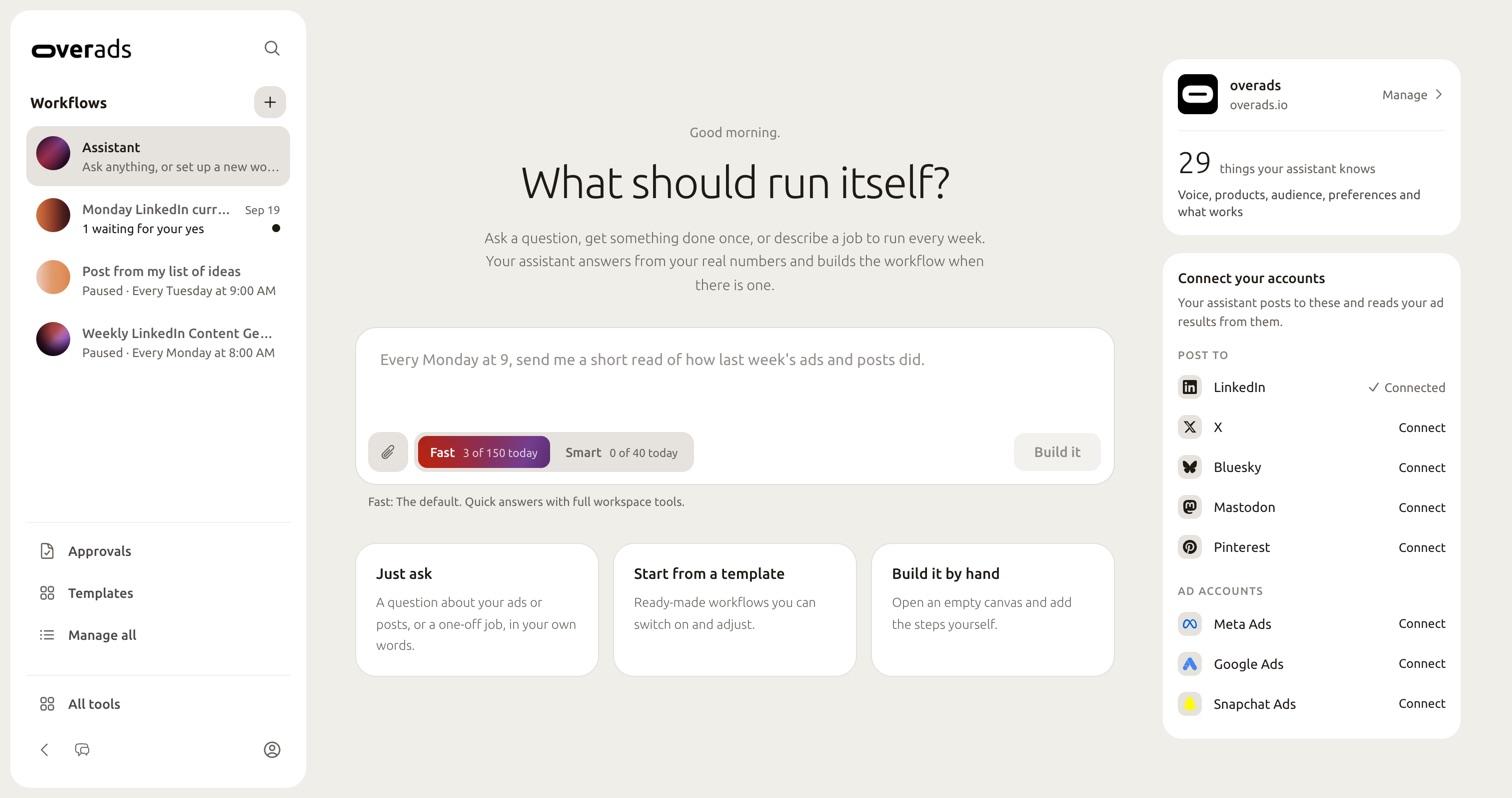
overads is the agent row in this comparison, and it covers a different part of marketing from the other nine. It drafts and schedules posts to Instagram, Facebook, LinkedIn, X, Bluesky, Mastodon and Pinterest, with a social media scheduler underneath. On ad accounts, Meta and Google ad changes run after you approve them; X and Snapchat connect read-only, so overads proposes and a person applies. Workflows are built in chat or from starter templates, start out asking for approval, and can be raised to post on their own inside a time window and a daily limit. Runs have a daily cap and a monthly AI budget set by the plan, per the workflows docs. Owners and admins can turn on Require approval in Settings, which holds every post for a person's yes, per the scheduling and approvals guide. It is off until someone turns it on.
overads also has an outreach agent that writes to prospects by email and LinkedIn from your own mailbox and account. It is switched on workspace by workspace, and it is one-to-one outreach, not list email.
What overads does not do:
- It is not an email marketing platform. It has no newsletter builder, contact-list flows or SMS. Brevo, Mailchimp or ActiveCampaign fit that job.
- It is not a CRM automation suite. A team that runs sales and marketing from one contact record is better served by HubSpot.
- It does not react to store or product events. Klaviyo and Customer.io are built for that.
- It does not connect arbitrary apps. Zapier, n8n and Make do, and they can call overads as one step.
- It does not publish to Threads, YouTube and TikTok yet.
When overads fits: a small team whose repeating work is social posts, ad checks and weekly reports, and who wants each action to wait for a yes. Our page on AI marketing agents compares that kind of tool on its own terms, and the pricing page has the current plan.
Frequently asked questions
Is marketing automation the same as email marketing?
No. Email marketing sends a campaign to a list when a person presses send. Marketing automation sends or acts when a trigger fires, such as a signup, a purchase or a date, and can cover SMS, ads, social posts and CRM updates as well as email.
Can a small business run on a no-cost tier?
For a short while. On the pages read here, HubSpot's free tools allow 1 automated email action, Mailchimp's Free tier lists automation flows as not included, and Klaviyo's stops at 250 active profiles and 500 emails a month.
Will these prices hold through 2027?
Nobody outside the vendors knows. Every figure here is what the vendor's page showed on November 18, 2026, and several pages carried limited-time or new-customer offers. Check the page on the day you buy.
Sources
- Marketing Software Pricing. HubSpot. Accessed Nov 18, 2026.
- Marketing Automation Software. HubSpot. Accessed Nov 18, 2026.
- Platform Pricing and Features. ActiveCampaign. Accessed Nov 18, 2026.
- Mailchimp Pricing Plans. Mailchimp (Intuit). Accessed Nov 18, 2026.
- Pricing Plans. Brevo. Accessed Nov 18, 2026.
- Klaviyo Pricing. Klaviyo. Accessed Nov 18, 2026.
- Pricing and Plans. Customer.io. Accessed Nov 18, 2026.
- Plans and Pricing. Zapier. Accessed Nov 18, 2026.
- Pricing. n8n. Accessed Nov 18, 2026.
- Pricing and Subscription Packages. Make. Accessed Nov 18, 2026.
- Scheduling and approvals. overads. Accessed Nov 18, 2026.
- Workflows over the API. overads. Accessed Nov 18, 2026.
Drafted with AI assistance, then checked against primary sources and the product itself by the overads team.
Keep reading
Guides · 10 min read
Best AI marketing tools: eleven sorted by job, with how each limits AI use and who presses publish
Eleven AI marketing tools read on their own sites on November 9, 2026, from ChatGPT and Canva to Meta Advantage+ and HubSpot: the job each does, how it meters AI, and whether it acts on its own or waits for a person.
Workflows · 9 min read
n8n vs Zapier vs Make for social media automation: what one post costs in each
n8n bills a workflow run, Zapier an action step and Make every module, triggers included, so the same post to four networks costs 1, 4 or 5 units. A dated price count, native posting by network, and where approvals sit.
Workflows · 7 min read
Human in the loop AI for marketing: let the agent draft, keep a person on send
Human in the loop AI drafts and proposes; a person approves before anything goes out. Which marketing tasks are safe to automate, the guardrails that stop a workflow running away, and how Zapier, n8n and overads compare.
Automate the social and ads side, and keep the yes
overads drafts and schedules posts to Instagram, Facebook, LinkedIn, X, Bluesky, Mastodon and Pinterest. Workflows start out asking for approval, and an owner can hold every post for a person's yes.
Get started